

I'm Yan, Gaia Education's Online Courses Coordinator.
I love writing, climbing, practicing Yoga, and exploring sustainable ways of being on this beautiful planet.
Studying engineering in university, brought me more and more awareness of the importance of one's inner connection with the heart (as I felt very disconnected from it, struggling to accomplish external needs).
I've been passionate about transformative education for many years now. Since I crossed paths with the Ecovillage Movement and all its inspirations and surroundings I've been exploring and diving into all the possibilities of integral learning/unlearning.
I live in Brazil and part of my journey has been integrating all this learning into the communities I'm part of and supporting the emerging of the world my heart knows it's possible.
I'm Yan, Gaia Education's Online Courses Coordinator.
I love writing, climbing, practicing Yoga, and exploring sustainable ways of being on this beautiful planet.
Studying engineering in university, brought me more and more awareness of the importance of one's inner connection with the heart (as I…
LEARNING LEADERSHIP
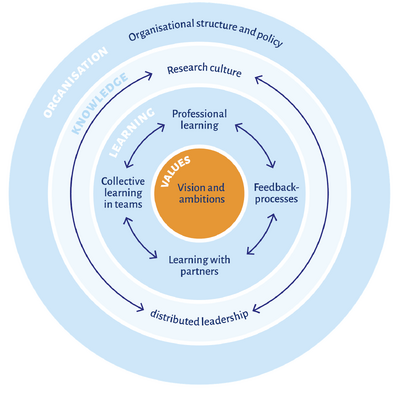
Module 3 Section B, Learning Leadership, shifts focus to your role as a leader. Discover how to publicly engage with soil science (e.g., joining student soil tests or sharing your learning journey in staff meetings). When teachers see you grappling with soil pH data or asking questions, you give permission for curiosity to thrive school-wide. A learning leader in the context of European education is a dynamic role that transcends traditional managerial duties. It involves fostering a culture of continuous learning and development within the school environment. As a learning leader, a school head is responsible for setting a clear educational vision that inspires both staff and students to strive for excellence and innovation. Learning leaders prioritize creating an inclusive and supportive atmosphere where every student’s potential can be realized. They work proactively to integrate diverse learning styles and needs into the curriculum, ensuring that education is accessible and equitable for all. This role requires you to be facilitators of professional development, encouraging teachers to adopt new pedagogical strategies and engage in lifelong learning. Moreover, a learning leader values collaboration and community engagement. They build partnerships with parents, local organizations, and global networks, promoting shared responsibility for educational success. By leading with empathy and openness, they cultivate an environment where feedback is welcomed and utilized to drive improvement and innovation. Incorporating modern technologies and methodologies is also a symbol of a learning leader. This includes advocating for digital literacy and critical thinking skills that prepare students for the challenges of the future. Importantly, a learning leader in the European context is attuned to the diverse cultural perspectives within their school community, using these as strengths to enrich the learning experience. Ultimately, a learning leader is an inspirational figure who nurtures an educational ecosystem that is vibrant, progressive, and inclusive, prioritizing the holistic development of students and staff alike. Take a look at this model of the 8 dimensions of a learning organisation. If you want to learn more about this topic, check out the HEADstart series: https://www.esha.org/academy/headstart

RISK MANAGEMENT
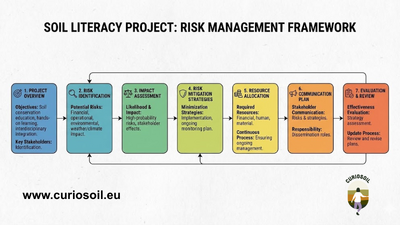
Empowered teams need guardrails. Section 4, Risk Management, tackles the practical realities that keep school heads awake: What if a student is injured in the garden? What if a compost project triggers parent complaints? We’ll translate anxiety into action, developing checklists for liability, crafting communication templates for controversies, etc. When thinking about implementing a soil literacy project, it is helpful to reflect on risk management. Read and answer the following questions and write a summary of your thoughts. 1. Project Overview: - What are the main objectives of your soil literacy project? (eg. educate students about the important roles of soils in the environment, soil ecosystem services, soil properties, ecosystem services the soil provide, role of soil in ecosystems, soil protection, health, and soil management in different land uses? Provide hands-on learning opportunities through soil exploration of different soil types, simple indoor soil analyses, gardening, and ecosystem exploration, art creativity? Integrate soil literacy into multiple subjects (science, geography, health, etc.) to encourage interdisciplinary learning?) - Who are the key stakeholders involved? 2. Risk Identification: - What potential risks could affect the implementation of this project (e.g., financial, operational, technical, environmental, etc.)? - Are there any risks related to weather conditions or environmental changes that could impact the project? 3. Impact Assessment: - Which risks are most likely to occur, and what would be their impact? - How would these risks affect the different stakeholders involved? 4. Risk Mitigation Strategies: - What strategies can be implemented during the project to minimize the likelihood and impact of identified risks, and how can the project be adapted to achieve its objectives if such risks cannot be fully prevented? - How will the project team identify risks and assess their potential impact and level of threat to the successful delivery of the project? 5. Resource Allocation: - What resources (financial, human, material, and operational resources such as the required environment, workspace equipment, and safety equipment) are required to manage these risks? - How will you ensure that risk management is a continuous process during the project? 6. Communication Plan: - How will you efficiently communicate risks and mitigation strategies to stakeholders? - Who will be responsible for disseminating information about risk management updates? 7. Evaluation and Review: - How will you evaluate the effectiveness of your risk management strategies? - What process will you use to review and update risk management plans as needed? Share your thoughts and reflections with others here and check out your peers' reflections too. Practical Tips: Engage stakeholders early: Involve teachers, students, parents, and community members in the planning stages to identify potential risks from different perspectives. Conduct site analysis: Before starting the project, assess the soil and environmental conditions to anticipate challenges and ensure informed decision-making during project planning. Pilot small-scale initiatives: Begin with smaller, manageable pilot projects to identify potential issues before a full-scale implementation. Regular monitoring: Establish a schedule for regular check-ins and assessments to ensure the project is on track and risks are mitigated promptly. Flexible planning: Build flexibility into your project timeline and plans to adapt to unforeseen challenges or delays. Documentation: Keep thorough records of all risk assessments, decisions, and changes made during the project to help with future planning and accountability. Soil literacy, when led with intention, models how to build resilient and inclusive learning communities. Through this module, you’ve moved from ensuring diverse voices shape soil initiatives (Section 1) to leading by learning (Section 2), fostering staff agency (Section 3), and safeguarding progress (Section 4). Remember: Your greatest tool isn’t control, it’s strategic empowerment. A science teacher discussing soil ecosystem services and troubleshooting soil contamination with students, a custodian mentoring a composting club, or a parent donating rain barrels becomes your leadership legacy. When risks arise (and they will), lean on the systems you’ve built: your inclusive coalitions, your learning-focused culture, your shared ownership. Soil isn’t just underfoot, it’s a mirror of your school’s health. Tend it wisely, and you will cultivate a place where roots run deep, and growth is inevitable.

Please see the changes to the text in the document below.

Done

Pls. See attached comment.
Done
Implementing raised garden beds in schools
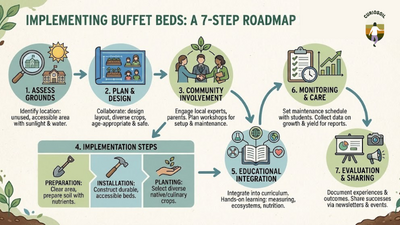
With your action plan designed (previous lesson), it’s time to ground strategy in a high-impact, low-barrier project: raised garden beds. These modular, no-till garden systems are ideal for schools, requiring minimal space, budget, or expertise while maximizing student engagement and cross-curricular links. This section provides a useful roadmap on how to implement raised garn beds in your school.. For school heads, raised garden beds offer a visible quick win, transforming underused courtyards into learning hubs that attract community support and tangibly showcase your soil literacy commitment. Raised garden beds are innovative educational installations that allow students to engage with and learn about sustainable food production on a smaller scale. Get inspired by some school gardens examples here and here. By considering the following pros and cons, and implementing the solutions provided, your school can effectively incorporate raised garden beds, maximizing educational and communal benefits while addressing potential obstacles. Pros and cons of implementing raised garden beds in schools Pros Hands-on learning: Provides students with practical experience in growing and maintaining plants, reinforcing classroom learning with real-world application. Environmental awareness: Enhances students' understanding of food origins, biodiversity, and sustainable agricultural practices. Interdisciplinary education: Offers opportunities to integrate various subjects such as science, health, geography, and even arts into the learning process. Community engagement: Encourages collaboration with local experts, gardening clubs, parents, or retirement homes, strengthening community ties and support. Nutrition and health education: Educates students about the benefits of fresh produce and fosters healthier eating habits. Skill development: Promotes skills like teamwork, responsibility, and project management as students care for the plants. Cons and solutions Space limitations Solution: Use vertical gardening techniques or container gardening if horizontal space is limited. Opt for smaller, densely-planted beds that maximize growing area without large space requirements. Initial costs Solution: Seek out grants or sponsorships from local businesses. Consider using recycled materials for bed construction and sourcing seeds from donations or community seed banks. Maintenance challenges Solution: Develop a structured maintenance schedule integrated into class routines or after-school clubs to ensure consistent care. Involve students, staff, and community volunteers. Pest and disease management Solution: Implement organic pest control methods and companion planting strategies. Educate students about integrated pest management practices. Seasonal restrictions Solution: Utilize greenhouses or indoor grow lights to extend growing seasons. Select crops suited to local climatic conditions and seasonal cycles. Use the winter to focus on theory and planning, then apply what you’ve learned in a practical way during the warmer outdoor season. Vandalism and security Solution: Position beds in a monitored area and use school campaigns or signage to cultivate respect and ownership among students. Implement protective measures like fencing. Include as many students and people from the local community as possible throughout the year - people are far less likely to destroy what they have helped build. Organise an art contest to design a logo for the raised beds, and install an informational sign. Students' disinterest Solution: Find out what students like and integrate their preferences into the garden bed activities. You may also discuss together in class how to include diverse interests. The following steps will help you implement raised garden beds in your school. 1. Assess school grounds: Identify a suitable location within school premises – preferably an unused or easily accessible area with sufficient sunlight and water access. 2. Plan and design Collaborate with teachers and students to design the raised garden bed layout. Include a variety of crops to ensure diverse learning opportunities. Ensure the design is age-appropriate for students to interact safely. 3. Community involvement Engage local gardening clubs, agricultural experts, or parent volunteers for expertise and resources. Plan workshops with these stakeholders to educate staff and students about setup and maintenance. 4. Implementation Steps Preparation: Clear the chosen area and prepare the soil, adding necessary nutrients. Installation: Construct the beds with durable materials, ensuring they are accessible for all students. Planting: Select a variety of crops – consider native plants or those that reflect the school’s culinary classes for broader application. 5. Educational integration Integrate the raised garden beds into the school curriculum across subjects – science, geography, and health education. Use them for hands-on learning activities, such as measuring growth, understanding ecosystems, and learning about nutrition. 6. Monitoring and care: Set up a maintenance schedule involving students, facilitating continuous care and monitoring through class projects or extracurricular clubs. Implement data collection on growth and yield, integrating findings into annual reports or science fairs. 7. Evaluation and sharing Encourage students to document their experiences and learning outcomes. Share successes and challenges through school newsletters or community events to inspire similar initiatives. Reflect on the pros and cons, the steps of action, and post in the forum about your decision on whether to implement raised garden beds. If you decide to start, here are some tips: Define the team. Who will be involved in planning and setting up? Define the disciplines involved. What subjects or themes will be linked? Science? Geography? Arts? How will you ensure regular maintenance? How will you evaluate success? Student reflections? Data on plant performance? Teachers' reactions? Parents/community response? How will you share your journey? School newsletter? Community event? MOOC forum? Video/photo documentation? Soil literacy, when strategically embedded, becomes a signature of your school’s identity. From defining objectives (Section 1) to advocating for resources (Section 2), greening curricula (Section 3), and planning for scale (Section 4), you’ve built a framework for systemic change. Now, with raised garden beds (Section 5), you have a launchpad—a low-cost, high-impact project that makes soil stewardship visible to students, staff, and the community. Remember: Leadership isn’t about doing it all yourself. Empower your science teacher to lead bed construction. Let the math class calculate soil volume ratios. Task student clubs with seasonal planting. Your role is to align these efforts with accreditation goals, secure sustainable funding, and celebrate outcomes—whether it’s a harvest meal in the cafeteria or data from a student-led soil health study. As budgets tighten and priorities shift, return to this truth: Soil is a powerful systems thinker’s tool. It connects science to food justice, art to ecology, and community partnerships to student agency. Start small (one grade level, one funded project) but think big. Measure success not just in test scores, but in student pride pointing to a regenerated patch of earth and saying, "We did this." That’s the leadership legacy you’re building.

This section is really nice, well done! :) I especially like the summary and call for action in the end of the section. Still, I have some suggestions:
I've never heard the term "buffet beds" before. How about rephrasing to "raised garden beds" instead (in the whole module)? From a quick search on the internet "raised garden beds" seems to be a much more common expression.
Section 4 (individualised action plan) is not yet online, at least for me, it doesn't show.
To improve the reading flow I suggest to add to this sentence: "Section 5 provides a useful roadmap on how to implement raised garn beds in your school."
The first link (http://rhs.org.uk...) doesn't work. When I click on it I get the error message "Sorry, we couldn't find that page. The page may have been moved or deleted."
-
Regarding the "Pros" section - you could add retirement homes here. In our experience gardening is a good way to connect generations:
Community engagement: Encourages collaboration with local experts, gardening clubs, parents, or retirement homes, strengthening community ties and support.
-
Regarding this con, you could add another solution:
Seasonal restrictions
Solution: Utilize greenhouses or indoor grow lights to extend growing seasons. Select crops suited to local climatic conditions and seasonal cycles. Use the winter to focus on theory and planning, then apply what you’ve learned in a practical way during the warmer outdoor season.
-
Regarding this con, you could add more solutions:
Vandalism and security
Solution: Position beds in a monitored area and use school campaigns or signage to cultivate respect and ownership among students. Implement protective measures like fencing. Include as many students and people from the local community as possible throughout the year - people are far less likely to destroy what they have helped build. Organise an art contest to design a logo for the raised beds, and install an informational sign.
-
What I'm missing here is that some students simply are not interested in gardening. Colleagues of mine have implemented raised beds and a school garden before and this aspect can be one to struggle with. So, my suggestion is to add as a con:
Students' disinterest
Solution: Find out what students like and integrate their preferences in the garden bed activities. You may also discuss together in class how to include diverse interests.
the theory-to-action figure could have better quality
Thanks for the great suggestions!
All done but the image quality and forum link
Designing an action plan
A curriculum shift without implementation is merely paperwork. Section 4, Designing an Action Plan, bridges strategy to reality. You’ll build a phased rollout: Year 1 might pilot a school garden with science classes; Year 2 expands to art/community partnerships. Crucially, we’ll embed accountability, assigning team leads, securing sustainable funding (e.g., PTA partnerships), and aligning with accreditation goals to ensure longevity. Think through the following steps and make short notes. 1. Action Steps List 3-5 key actions you will take upon completing the MOOC (e.g., developing a school-wide project, launching a teacher training session). My actions will be: ………………………………………………………………………………………………………………………………. 2. Timeline Establish a realistic timeline for implementing your action steps. Include short-term and long-term goals. Short term: (eg. next 3 months) ……………………………………………………………………………………………………………………. Long term: (eg. 6-12 months) …………………………………………………………………………………………………………………….. Tip: Use calendar reminders to stay on track. Add a monthly check-in. 3. Support & Resources Identify supports available to you (e.g., school board, local environmental groups) and additional resources needed. Plan how to access these supports and resources to achieve your objectives. Ask yourself: Who can help me? What support do I need (money, time, tools, info)? How will I reach out? ………………………………………………………………………………………………………………………………. 4. Monitoring & Evaluation Determine how you will measure the success and impact of your actions (e.g., student engagement metrics, feedback from colleagues). Plan for periodic review and adjustment of your action plan to ensure effectiveness. ………………………………………………………………………………………………………………………………. Indicators of success: Who will give feedback? When will I review and update this plan? Final tip: Keep your plan visible—in your planner, office, or teaching portfolio. Action starts with intention… but it succeeds with small steps, support, and self-reflection.
At the end of the last sentence (Final tip:) there is a "." missing.
Is it possible to include an option for downloading these instructions as a separate file?
Done
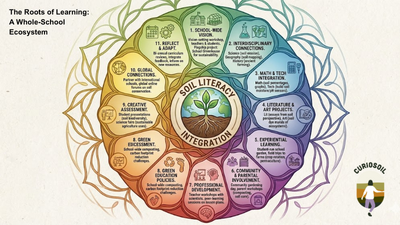
Greening the curriculum: Soil Literacy Integration
Advocacy opens doors; Section C of Module 2 ensures what’s taught inside them reflects your vision. Guidance on Greening the Curriculum provides templates to audit existing programs, integrate soil concepts across subjects (e.g., linking soil chemistry to math data units or land history to social studies), and train staff without overwhelming them. Forget top-down mandates, focus on scalable "lighthouse projects" that model success and attract organic adoption. Read the following tips on how soil literacy can be integrated into your curriculum. Choose at least one that you like best and think you could implement and commit to take steps forward by finishing the three sentences: In a week I will… In a month I will… In a year I will… Post your reflections in the forum and comment on at least one peer’s plan. 1. Develop a school-wide vision: Hold a vision-setting workshop with teachers and students to brainstorm ideas for integrating sustainability, focusing on creating a school greenhouse as a central project (e.g. organise a visioning workshop with teachers and students with the aim of co-creating a plan to build a school greenhouse as a flagship project for sustainability). 2. Establish interdisciplinary curriculum connections: In Science, conduct soil erosion experiments and explore organic vs. inorganic soil components in classroom labs. In Geography, map soil types in the local area and analyze how they have shaped local agriculture and settlement patterns. In History, research and present on ancient farming techniques and their reliance on soil health, such as the three-field system in medieval Europe. 3. Integrate Soil Literacy in Mathematics and Technology: Use soil sample composition to calculate percentages and graph results in Math classes. Develop a Technology project where students build simple sensors or coding tools to measure soil moisture or pH levels. 4. Enhance literature and art projects: Assign Literature classes to write essays or short stories from the perspective of soil during different historical periods. In Art, create a mural using natural dyes made from different soil samples, illustrating local ecosystems or community history. 5. Promote experiential learning: Develop a student-run school garden where different classes can plant and maintain plots based on lessons learned in class. Organize field trips to nearby farms for students to learn about practices like crop rotation and permaculture roadside. 6. Encourage community and parental involvement: Host a community gardening day inviting local horticulturists to discuss soil care, encouraging intergenerational knowledge exchange. Parents can participate in workshops where they and students work together on sustainable practices like composting at school. 7. Provide professional development: Organize teacher workshops with local environmental scientists discussing new research in soil conservation. Facilitate peer-learning sessions where teachers share successful soil literacy lesson plans and outcomes. 8. Implement green education policies: Launch a school-wide composting program, turning food waste into valuable soil amendments for the school garden. Set a challenge for each class to reduce their carbon footprint, presenting findings at a school assembly. 9. Utilize creative assessment methods: Use student presentations on soil biodiversity as part of their assessment in Biology. Facilitate science fairs where projects focus on innovative uses of soil in sustainable agriculture. 10. Foster global connections: Partner with a school in another country to compare soil health practices across diverse climates and cultures. Engage students in global online forums discussing international soil conservation efforts. 11. Reflect and adapt: Schedule bi-annual curriculum reviews where professional educators assess the impact of soil literacy projects and integrate student feedback to refine future efforts. Keep faculty informed about new soil and sustainability-related educational resources. Reflection task How do these ideas fit to your subject and school context? Share your commitments for 1 week, 1 month and 1 year... You can also comment on another colleague's plan and offer a suggestion or encouragement :)
Is it possible to improve the quality of the figure? It's hard to read this way both directly on the page and when I download.
There is a lot of space between the figure and the reflection task. Is it possible to delete this space?
Regarding the reflection task: I'm confused by the phrasing of the question "How does this activity fit into your subject and school context?". If the tips are meant, please rephrase e.g. like "How do these ideas fit to your subject and school context?"
-
In the last sentence, the . at the end is missing.
"You can also comment on another colleague's plan and offer a suggestion or encouragement. :)"
The link to the forum for the reflection task does not work (error message "404 Page Not found").
Done, only missing high quality image here.
PRACTICES AND TIPS TO FOSTER INCLUSIVITY
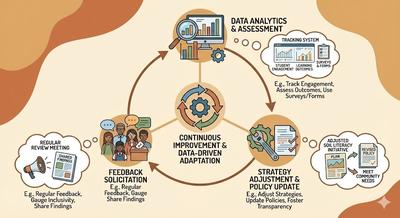
Promote a culture of respect and belonging: Develop a school ethos that celebrates diversity by organizing multicultural events and activities. Encourage open discussions about diversity and inclusion in school assemblies and classes. Address and challenge discriminatory behaviour immediately through restorative practices. E.g. Organize a "Soil Festival" to celebrate the diverse cultures and traditions connected to soil stewardship globally. Include storytelling sessions where students from various backgrounds share traditional farming or soil conservation practices from their cultures. Incorporate soil-related topics in school art and history projects, encouraging students to explore and present their cultural connections to soil and agriculture. Provide equitable learning opportunities: Ensure resources are distributed based on students' needs, with additional support for those facing language barriers or learning difficulties. Introduce differentiated instruction techniques to cater to various learning styles and abilities. Invest in assistive technologies that aid learning for students with disabilities. E.g. Introduce soil-based hands-on science projects, tailored to different learning levels, such as growing plants in varied soil types and observing differences. Set up a school garden or a small-scale farm where students can engage in experiential learning. Ensure accessibility for students with disabilities by including raised garden beds and providing ergonomic gardening tools. Utilize digital platforms with interactive soil-related simulations and activities that cater to diverse learning styles. Collect soil samples, drying and sieving them, then use them for creative activities Engage the community: Build partnerships with parents, local businesses, farmers, and community organizations to create a support network for students. Organize regular forums and workshops involving teachers, parents, and community members to discuss and implement inclusive strategies. Encourage volunteerism and mentorship programs to foster community engagement. E.g. Partner with local agricultural experts or environmental groups to host workshops for students and parents on soil health and conservation. Organize community gardening days that include workshops on soil types and planting techniques, allowing community members to share expertise and cultural practices regarding soil. Professional Development for Staff: Provide regular training for teachers on inclusive education practices and cultural competence. Encourage staff to share inclusive teaching strategies through professional learning communities. E.g. Support continuous learning by offering access to educational resources and workshops. (Check out our MOOC 2.2. LINK!) Offer teachers professional development sessions on integrating soil literacy into different curricula, such as science, geography, and social studies. Facilitate teacher exchanges or collaborations with schools that have successful soil literacy programs to share best practices and resources. Create an accessible environment: Conduct accessibility audits to ensure facilities cater to students with physical disabilities, such as ramps and accessible restrooms. Display clear signage and use visuals to aid navigation for all students. Ensure that classrooms are arranged to accommodate students' physical and sensory needs. E.g. Construct an accessible outdoor learning area for soil studies, including paths suitable for all mobility devices. Use tactile teaching tools and large print or audio resources for students with visual impairments during soil-related activities. Policy Development: Develop policies that clearly outline the school’s commitment to diversity and inclusion. Adapt curricula to reflect diverse cultures, ensuring representation of various perspectives and histories. E.g. Establish a reporting mechanism for discrimination or bias incidents, ensuring a safe and respectful environment. Draft policies that prioritize soil conservation education as part of the school’s commitment to sustainability and inclusivity. Revise existing curricula to incorporate soil literacy topics across subjects, ensuring representation of soil’s environmental, economic, and cultural significance. Monitoring and Evaluation: Use data analytics to assess the effectiveness of inclusion strategies and identify areas for improvement. Solicit feedback from students, parents, and staff regularly to gauge inclusivity efforts. Adjust strategies and policies based on feedback and data analysis to better meet the needs of the school community. E.g. Implement a system for tracking student engagement and learning outcomes from soil literacy activities, using surveys and feedback forms. Regularly review soil literacy initiatives' impact and share the findings with the school community to foster transparency and encourage continuous improvement.
In the section Provide equitable learning opportunities, there is excessive spacing at the beginning of the examples text. One example of a project could be collecting soil samples, drying and sieving them, then students could use it for creative activities.
In the section Professional Development for Staff, it would be beneficial to include training for teachers on different teaching approaches that address diverse student needs. Teachers could participate in seminars or workshops for this purpose. Additionally, a link is missing in the text.
In the section Create an accessible environment, the first bullet point contains an incomplete sentence and needs to be finished (“E.g. when …”).
@Katja Črnec Done
The spacing between individual paragraphs needs to be reduced in some places to create a more consistent look. At the end of the lesson, the downloadable picture does not appear in a small overview as it does in other modules.
Done