

SUSTAINABILITY
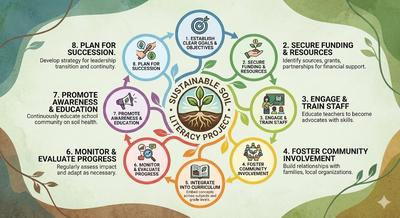
Module 4.D ensures it outlasts your tenure. Sustainability focuses on embedding soil literacy institutionally: training "Soil Champion" teachers, weaving garden maintenance into facilities budgets, or making soil projects a pillar of new staff orientation. We’ll confront attrition risks head-on, because true sustainability means the garden thrives when you’re pulled into the next crisis meeting. If you have managed to implement a successful project you need to make your success sustainable. Taking the following steps will ensure that your soil literacy project remains effective and sustainable over the long term. Steps to ensure sustainability: 1. Establish Clear Goals and Objectives: Define the long-term aims of the soil literacy project and how they align with the school’s mission and educational goals. 2. Secure Funding and Resources: Identify potential funding sources, grants, or partnerships to provide financial support and resources needed for the project’s continuation. 3. Engage and Train Staff: Educate and involve teachers and staff to become advocates and facilitators of the project, ensuring they have the necessary knowledge and skills. 4. Foster Community and Stakeholder Involvement: Build strong relationships with families, community members, local organizations, and experts to create a network of support. 5. Integrate into Curriculum: Embed soil literacy concepts into the school curriculum across multiple subjects and grade levels to ensure consistent delivery. 6. Monitor and Evaluate Progress: Regularly assess the project’s impact and effectiveness through student feedback and project metrics and adapt as necessary. 7. Promote Awareness and Education: Continuously educate the school community and promote awareness about the importance of soil health and sustainability. 8. Plan for Succession: Develop a strategy for leadership transition and continuity, ensuring the project can sustain itself beyond the current team’s involvement. The following checklist will help you make sure that you have considered all major aspects of making your efforts sustainable. Check it out and write a short reflection on which step you find the most problematic and why. Checklist for long-term sustainability: Set clearly defined goals and objectives aligned with school values. Identify and secure funding sources and partnerships. Provide training and resources for staff to ensure effective project delivery. Build and maintain strong relationships with community and external partners. Incorporate soil literacy into the school’s curriculum. Establish a system for regular monitoring and evaluation. Develop ongoing awareness and educational initiatives. Create a succession plan for leadership and project continuity. Take a moment to reflect (and share in the forum): Which of the above steps do you anticipate being the most challenging and why? Soil governance, done right, can transform your school’s ecosystem. You’ve moved from engaging parents as decision-makers (Section 4.1) to mobilizing the whole community as co-owners (Section 4.2), amplifying impact through targeted communication (Section 4.3), and locking in longevity (Section 4.4). Remember: Your goal isn’t a perfect program, it’s a self-replenishing culture. When budgets tighten or stakeholders waver, lean on the systems you’ve built. That parent-led soil safety protocol? It’s now policy. The partnership with the local nursery? It’s in the 5-year plan. Your legacy isn’t a garden, it’s the blueprint for how your school turns values into value. Soil teaches us: Depth creates resilience. Dig deep here, and your leadership roots will hold.

Communication and Disseminations of a Soil Literacy Project
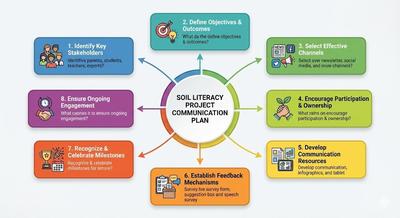
Even thriving partnerships stall without strategic storytelling. Section 3, Communication & Dissemination, equips you to showcase impact in ways that work for you. Turn soil projects into accreditation evidence ("See our cross-curricular soil module in our renewal report"), parent pride points ("Your child presented soil data to the town council"), or funding proposals ("Our compost program reduced waste costs by 30%"). Templates will help you delegate this: task student clubs with social media, or a teacher with grant-writing. Answering the following questions will help you think through the steps you need to take when communicating and disseminating your soil literacy project. Questions: 1. Who are the key stakeholders involved in the soil literacy project? Identify parents, students, teachers, local experts, and community organizations. 2. What are the main objectives and expected outcomes of the soil literacy project? Clearly define the goals and benefits for the school and community. 3. What communication channels are most effective for reaching each stakeholder group? Consider newsletters, social media, school meetings, and local events. 4. How can you encourage stakeholder participation and ownership in the project? Explore ways to involve stakeholders in planning and execution. 5. What resources and materials are needed to effectively communicate the project’s progress? Identify informational documents, visual aids, and digital content. 6. What feedback mechanisms should be in place to gather stakeholder input? Include surveys, suggestion boxes, and open forums for discussion. 7. How will you recognize and celebrate milestones and successes of the project? Plan events or communications to highlight achievements. 8. How can you ensure ongoing engagement and communication throughout the project’s lifecycle? Establish regular updates and checkpoints with stakeholders. The following checklist will help you make sure that you have considered all major aspects of communication and dissemination. Checklist: Identify and segment key stakeholders for targeted communication. Define clear objectives and outcomes for the project. Develop a communication plan with tailored strategies for each stakeholder group. Select and utilize effective communication channels (e.g., newsletters, social media). Create accessible and engaging resources/materials (e.g., brochures, infographics). Establish feedback loops for stakeholder input and adapt communication strategies accordingly. Schedule regular updates and keep stakeholders informed of project progress. Plan recognition and celebration of key milestones to maintain enthusiasm and support. Ensure long-term communication strategies are in place for continued engagement. Check out this guide on effectiveness communications by the Ministry of Education of New Zealand. This Schools Public Relations Best Practices can give you insights on your communications endeavours;

Infographics and checklist seem complete and well done.
The whole school Approach
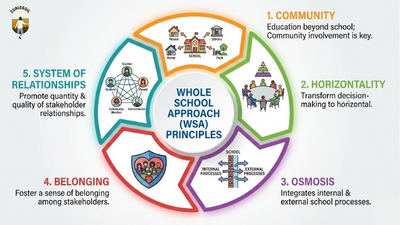
Parents invested? Now expand their role from supporters to co-architects. Section 2 shifts to whole-community engagement, where local farmers, businesses, and elders become governance partners. Learn to structure "Soil Stewardship Councils" that share ownership (e.g., a cafe owner donating compost bins, a retired agronomist advising student labs). This isn’t volunteerism, it’s resource diplomacy, converting community goodwill into tangible assets while distributing leadership burdens. The Whole School Approach (WSA) is an educational strategy that involves collective and collaborative action among learners, staff, and the broader community to enhance learning, behavior, and wellbeing across the entire school environment, fostering inclusivity and community involvement. This short animation shows an example of a WSA working: Principles of WSA: Community: Education extends beyond school; community involvement is key. Horizontality: Transform decision-making processes from hierarchical to horizontal. Osmosis: Integrates internal and external school processes. Belonging: Schools should foster a sense of belonging among stakeholders. System of relationships: Promote both the quantity and quality of stakeholders' relationships. Challenges: Community outsiders: Professionals may lack community integration; mutual cultural understanding is needed. Social class: Aim for equity but integrate diverse social groups. Digital: Question virtual community effectiveness in WSAs. Sustainability: WSA processes are sensitive to change; long-term sustainability is complex. Participation: Crucial for WSA; requires reformulating participation, reconstructing spaces, and rethinking strategies to enhance stakeholder involvement. The following practical tips can help you implement the whole school approach: Integrate soil education across curricula: Embed soil-related topics into various subjects like science, geography, and art to provide students with a comprehensive understanding of soil ecology and its significance. Create outdoor learning spaces: Develop school gardens or composting areas where students can engage in hands-on learning about soil health, sustainability, and biodiversity. Engage the community: Involve local experts, farmers, and environmental organizations to participate in school programs, providing insights and resources for soil-related projects. Host interactive workshops: Organize workshops and seminars for students, parents, and staff to learn about soil conservation practices and the role of healthy soil in the ecosystem. Develop student-led projects: Encourage student-led initiatives that focus on soil activities, such as soil testing experiments or community presentations on soil preservation. Incorporate technology: Use digital tools and platforms to explore soil science, like virtual soil collections, soil health monitoring apps, and interactive modeling tools. Encourage students to explore soil data online, engage with interactive maps, and analyze soil conditions globally. Establish a soil literacy committee: Form a committee with teachers, parents, and students to plan and oversee soil literacy activities, ensuring diverse input and sustained engagement. Regularly evaluate and adapt: Continuously assess the effectiveness of soil literacy initiatives and be open to adapting strategies based on feedback and changing educational needs. Check out this MOOC to learn more about Teaching Sustainability Awareness from a whole systems perspective
To me, this stricture seems rather optimistic. In the real world, do parents have enough time to participate to the suggested extent in such a complex (though I agree, holistic) approach? If they do at the beginning, how long will it last? How can the will and engagement be maintained?
Perhaps a less complex and less time-consuming approach to participation and engagement would be more successful and sustainable.
ENGAGING PARENTS
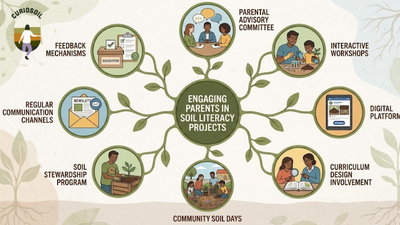
Engaging parents in a soil literacy project can greatly enhance school governance and foster a sense of community. Consider the tips below, choose one or two and note your thoughts about how you would implement it. Establish a parental advisory committee: Form a committee consisting of enthusiastic parents to help oversee the soil literacy project. This group can provide valuable input, assist in decision-making, and act as a liaison between the school and the wider parent community. Check out this article by Harvard's Graduate School of Education. Also this about Parent-Teacher Partnership. Organize interactive workshops: Host workshops where parents can learn alongside students about soil health, sustainable practices, and the importance of soil in daily life. Providing hands-on experiences can increase their involvement and commitment. Utilize digital platforms: Create an online portal or social media group dedicated to the project, where parents can find resources, share their own experiences, and contribute ideas for activities and curriculum enhancements. Involve parents in curriculum design: Invite parents with expertise in environmental science, agriculture, gardening or related fields to collaborate with teachers in designing and refining the curriculum. This inclusion can bring fresh perspectives and innovative ideas. Organize community soil days: Plan events where parents and their families can participate in activities such as soil testing, gardening workshops, environmental art projects related to soil conservation or creating compost. These events strengthen the school community and raise awareness about soil conservation. Link Suggestion – EU project for School Garden Material Develop a soil stewardship program: Encourage parents to volunteer as “Soil Stewards” who help maintain school gardens or conduct soil-related activities. Recognize and reward their contributions to build a stronger engagement culture. Set up regular communication channels: Ensure that parents are kept informed about the project’s progress, challenges, and successes through newsletters, emails, or regular meetings. Clear and consistent communication can foster transparency and trust. Incorporate feedback mechanisms: Establish ways for parents to provide feedback on the project's implementation and outcomes. This can be done through surveys or suggestion boxes, allowing them to voice their opinions and feel valued in the governance process.
To me, this stricture seems rather optimistic. In the real world, do parents have enough time to participate to the suggested extent in such a complex (though I agree, holistic) approach? If they do at the beginning, how long will it last? How can the will and engagement be maintained?
Perhaps a less complex and less time-consuming approach to participation and engagement would be more successful and sustainable.
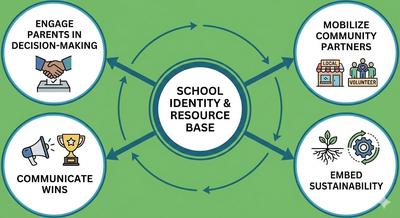
PARENTAL ENGAGEMENT
For school heads, soil literacy isn’t just curriculum, it’s community capital. Between budget reviews, parent expectations, and the push for "sustainable schools," you need frameworks that turn soil projects into strategic assets. This module tackles governance: how to deeply engage parents in decision-making, mobilize entire communities as partners, communicate wins to strengthen trust, and critically-embed sustainability so initiatives survive leadership transitions. The goal is to build systems where soil literacy fuels your school’s identity, resource base, and impact long-term. To promote soil literacy through education, professional educators need to co-operate with the parents and the community, not only because it is impossible to make relevant changes in the thinking of future generations without them, but also because the ecological notion of "everything is linked to everything else” suggests such an approach. In order to achieve such co-operation, school governance (and the governance of education at higher levels) must be transformed significantly so that families and the community can become actively engaged in education policy making and school life. This will lead to children becoming more active citizens who understand the importance of soil. There is a growing consensus on the changing role of school and education that needs a change of approach from educating obedient workers for the assembly line to educating creative, critical thinkers for a world of accelerated change and less need for repetitive work done by people. Decreasing participation, especially of younger generations as active citizens in community, elections and civic life is a worldwide phenomenon. Participatory practices in schools, engaging parents, children, teachers, and others are effective for school stakeholders to experience active citizenship in a safe environment, as well as the consequences of opting out of decision-making. Both parental engagement and child participation also have a direct positive effect on the learning outcomes of the children and also support the lifelong learning of parents and teachers. Student and parent organisations have long advocated for participatory decision making in education at all levels, from European and national policy making to daily decisions at school or class level. This demand has only become more topical after the school closures of 2020–22 when the problems of education systems became more visible to parents, and also for students. For many, the need to attend formal education became questionable. Parent organisations have long argued for engagement and participation, and to make school a safe testing field for democratic citizenship skills. So far, the prevalent approach to citizenship education has been the inclusion of the domain in the curriculum and thus creating the framework for learning about citizenship and democracy. The Curiosoil project is an excellent opportunity to change the main trend of civic/citizenship education from learning about to learning by doing. A meta-analysis study of over 13 000 scientific publications proves that students learn far better if they can experience curricular content rather than just learning about them. This is why the educational materials of the Curiosoil project contain not only hands-on activities, but also elements of parental and community engagement. This also means that teachers have three very important tasks that hopefully this MOOC can help with: Understand and prepare for their role in supporting parents in general to become better educators of their children as well as more active citizens, starting from school contexts, Understand and prepare for their role in acknowledging child agency and providing opportunities for meaningful participation of children of all ages, and Be active citizens of their own school.
No particular comment; I have no changes to suggest.
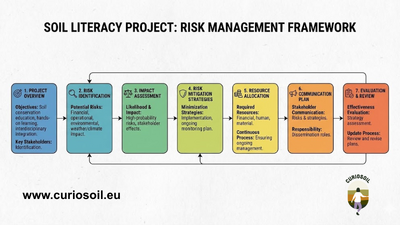
RISK MANAGEMENT
Empowered teams need guardrails. Section 4, Risk Management, tackles the practical realities that keep school heads awake: What if a student is injured in the garden? What if a compost project triggers parent complaints? We’ll translate anxiety into action, developing checklists for liability, crafting communication templates for controversies, etc. When thinking about implementing a soil literacy project, it is helpful to reflect on risk management. Read and answer the following questions and write a summary of your thoughts. 1. Project Overview: - What are the main objectives of your soil literacy project? (eg. educate students about the important roles of soils in the environment, soil ecosystem services, soil properties, ecosystem services the soil provide, role of soil in ecosystems, soil protection, health, and soil management in different land uses? Provide hands-on learning opportunities through soil exploration of different soil types, simple indoor soil analyses, gardening, and ecosystem exploration, art creativity? Integrate soil literacy into multiple subjects (science, geography, health, etc.) to encourage interdisciplinary learning?) - Who are the key stakeholders involved? 2. Risk Identification: - What potential risks could affect the implementation of this project (e.g., financial, operational, technical, environmental, etc.)? - Are there any risks related to weather conditions or environmental changes that could impact the project? 3. Impact Assessment: - Which risks are most likely to occur, and what would be their impact? - How would these risks affect the different stakeholders involved? 4. Risk Mitigation Strategies: - What strategies can be implemented during the project to minimize the likelihood and impact of identified risks, and how can the project be adapted to achieve its objectives if such risks cannot be fully prevented? - How will the project team identify risks and assess their potential impact and level of threat to the successful delivery of the project? 5. Resource Allocation: - What resources (financial, human, material, and operational resources such as the required environment, workspace equipment, and safety equipment) are required to manage these risks? - How will you ensure that risk management is a continuous process during the project? 6. Communication Plan: - How will you efficiently communicate risks and mitigation strategies to stakeholders? - Who will be responsible for disseminating information about risk management updates? 7. Evaluation and Review: - How will you evaluate the effectiveness of your risk management strategies? - What process will you use to review and update risk management plans as needed? Share your thoughts and reflections with others here and check out your peers' reflections too. Practical Tips: Engage stakeholders early: Involve teachers, students, parents, and community members in the planning stages to identify potential risks from different perspectives. Conduct site analysis: Before starting the project, assess the soil and environmental conditions to anticipate challenges and ensure informed decision-making during project planning. Pilot small-scale initiatives: Begin with smaller, manageable pilot projects to identify potential issues before a full-scale implementation. Regular monitoring: Establish a schedule for regular check-ins and assessments to ensure the project is on track and risks are mitigated promptly. Flexible planning: Build flexibility into your project timeline and plans to adapt to unforeseen challenges or delays. Documentation: Keep thorough records of all risk assessments, decisions, and changes made during the project to help with future planning and accountability. Soil literacy, when led with intention, models how to build resilient and inclusive learning communities. Through this module, you’ve moved from ensuring diverse voices shape soil initiatives (Section 1) to leading by learning (Section 2), fostering staff agency (Section 3), and safeguarding progress (Section 4). Remember: Your greatest tool isn’t control, it’s strategic empowerment. A science teacher discussing soil ecosystem services and troubleshooting soil contamination with students, a custodian mentoring a composting club, or a parent donating rain barrels becomes your leadership legacy. When risks arise (and they will), lean on the systems you’ve built: your inclusive coalitions, your learning-focused culture, your shared ownership. Soil isn’t just underfoot, it’s a mirror of your school’s health. Tend it wisely, and you will cultivate a place where roots run deep, and growth is inevitable.
Pls. See attached comment.

Done
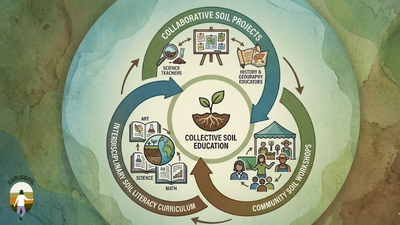
Collective Efficacy
Module 3.C, Cultivating Collective Efficacy, provides tools to turn individual interest into shared commitment. Learn to structure "soil solution teams" blending science, arts, and facilities staff; use protocols like "success mapping" to highlight small wins; and delegate authority so soil projects become everyone’s mission, not just your mandate. Cultivating collective efficacy in schools is crucial for driving meaningful and sustainable educational improvements. This concept refers to the shared belief among educators that through joint effort, they can positively impact student outcomes. For European school heads, fostering collective efficacy means building a collaborative culture where all staff members feel empowered and confident in their collective potential to enhance learning. Collective efficacy enhances motivation among teachers and staff, leading to a more resilient and adaptive educational environment. It encourages the sharing of best practices, inclusive decision-making, and mutual support, ultimately benefiting student learning experiences and achievement. Take a look at the following examples. Choose one or come up with a different idea that fosters collective efficacy. Note down a few thoughts on how you would present this idea to your staff. Collaborative Soil Projects Imagine a school-wide initiative where teachers across disciplines collaborate to develop a project focused on soil health. Science teachers could guide students in conducting soil quality tests, while history and geography educators could explore soil's role in historical agricultural practices. This joint effort not only enriches curricula but also reinforces the power of collaborative learning to address complex topics. Community Soil Workshops School heads can organize workshops on sustainable soil practices for the wider community. By involving teachers, students, and local experts (farmers, gardeners), these events become a platform for sharing knowledge and practices, exemplifying how collective action can lead to increased community engagement and learning. Interdisciplinary Soil Literacy Curriculum Developing an interdisciplinary curriculum around soil literacy can foster a sense of shared purpose among teachers. By integrating soil-related topics into various subjects, educators work together to provide students with a holistic understanding of soil's ecological and economic importance. This collective effort reinforces the belief that every teacher's contribution is crucial for holistic education. If you are interested to learn more, read HEADstart#7: Stimulating collective self-efficacy
Please see attached comments.
Well done checklist. Complete. Nothing to add from a content point of view.