

Designing an action plan
A curriculum shift without implementation is merely paperwork. Section 4, Designing an Action Plan, bridges strategy to reality. You’ll build a phased rollout: Year 1 might pilot a school garden with science classes; Year 2 expands to art/community partnerships. Crucially, we’ll embed accountability, assigning team leads, securing sustainable funding (e.g., PTA partnerships), and aligning with accreditation goals to ensure longevity. Think through the following steps and make short notes. 1. Action Steps List 3-5 key actions you will take upon completing the MOOC (e.g., developing a school-wide project, launching a teacher training session). My actions will be: ………………………………………………………………………………………………………………………………. 2. Timeline Establish a realistic timeline for implementing your action steps. Include short-term and long-term goals. Short term: (eg. next 3 months) ……………………………………………………………………………………………………………………. Long term: (eg. 6-12 months) …………………………………………………………………………………………………………………….. Tip: Use calendar reminders to stay on track. Add a monthly check-in. 3. Support & Resources Identify supports available to you (e.g., school board, local environmental groups) and additional resources needed. Plan how to access these supports and resources to achieve your objectives. Ask yourself: Who can help me? What support do I need (money, time, tools, info)? How will I reach out? ………………………………………………………………………………………………………………………………. 4. Monitoring & Evaluation Determine how you will measure the success and impact of your actions (e.g., student engagement metrics, feedback from colleagues). Plan for periodic review and adjustment of your action plan to ensure effectiveness. ………………………………………………………………………………………………………………………………. Indicators of success: Who will give feedback? When will I review and update this plan? Final tip: Keep your plan visible—in your planner, office, or teaching portfolio. Action starts with intention… but it succeeds with small steps, support, and self-reflection.

Implementing raised garden beds in schools
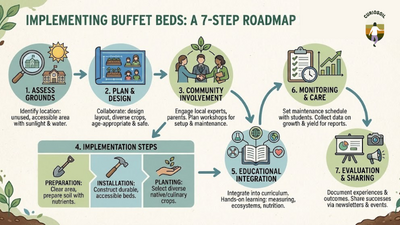
With your action plan designed (previous lesson), it’s time to ground strategy in a high-impact, low-barrier project: raised garden beds. These modular, no-till garden systems are ideal for schools, requiring minimal space, budget, or expertise while maximizing student engagement and cross-curricular links. This section provides a useful roadmap on how to implement raised garn beds in your school.. For school heads, raised garden beds offer a visible quick win, transforming underused courtyards into learning hubs that attract community support and tangibly showcase your soil literacy commitment. Raised garden beds are innovative educational installations that allow students to engage with and learn about sustainable food production on a smaller scale. Get inspired by some school gardens examples here and here. By considering the following pros and cons, and implementing the solutions provided, your school can effectively incorporate raised garden beds, maximizing educational and communal benefits while addressing potential obstacles. Pros and cons of implementing raised garden beds in schools Pros Hands-on learning: Provides students with practical experience in growing and maintaining plants, reinforcing classroom learning with real-world application. Environmental awareness: Enhances students' understanding of food origins, biodiversity, and sustainable agricultural practices. Interdisciplinary education: Offers opportunities to integrate various subjects such as science, health, geography, and even arts into the learning process. Community engagement: Encourages collaboration with local experts, gardening clubs, parents, or retirement homes, strengthening community ties and support. Nutrition and health education: Educates students about the benefits of fresh produce and fosters healthier eating habits. Skill development: Promotes skills like teamwork, responsibility, and project management as students care for the plants. Cons and solutions Space limitations Solution: Use vertical gardening techniques or container gardening if horizontal space is limited. Opt for smaller, densely-planted beds that maximize growing area without large space requirements. Initial costs Solution: Seek out grants or sponsorships from local businesses. Consider using recycled materials for bed construction and sourcing seeds from donations or community seed banks. Maintenance challenges Solution: Develop a structured maintenance schedule integrated into class routines or after-school clubs to ensure consistent care. Involve students, staff, and community volunteers. Pest and disease management Solution: Implement organic pest control methods and companion planting strategies. Educate students about integrated pest management practices. Seasonal restrictions Solution: Utilize greenhouses or indoor grow lights to extend growing seasons. Select crops suited to local climatic conditions and seasonal cycles. Use the winter to focus on theory and planning, then apply what you’ve learned in a practical way during the warmer outdoor season. Vandalism and security Solution: Position beds in a monitored area and use school campaigns or signage to cultivate respect and ownership among students. Implement protective measures like fencing. Include as many students and people from the local community as possible throughout the year - people are far less likely to destroy what they have helped build. Organise an art contest to design a logo for the raised beds, and install an informational sign. Students' disinterest Solution: Find out what students like and integrate their preferences into the garden bed activities. You may also discuss together in class how to include diverse interests. The following steps will help you implement raised garden beds in your school. 1. Assess school grounds: Identify a suitable location within school premises – preferably an unused or easily accessible area with sufficient sunlight and water access. 2. Plan and design Collaborate with teachers and students to design the raised garden bed layout. Include a variety of crops to ensure diverse learning opportunities. Ensure the design is age-appropriate for students to interact safely. 3. Community involvement Engage local gardening clubs, agricultural experts, or parent volunteers for expertise and resources. Plan workshops with these stakeholders to educate staff and students about setup and maintenance. 4. Implementation Steps Preparation: Clear the chosen area and prepare the soil, adding necessary nutrients. Installation: Construct the beds with durable materials, ensuring they are accessible for all students. Planting: Select a variety of crops – consider native plants or those that reflect the school’s culinary classes for broader application. 5. Educational integration Integrate the raised garden beds into the school curriculum across subjects – science, geography, and health education. Use them for hands-on learning activities, such as measuring growth, understanding ecosystems, and learning about nutrition. 6. Monitoring and care: Set up a maintenance schedule involving students, facilitating continuous care and monitoring through class projects or extracurricular clubs. Implement data collection on growth and yield, integrating findings into annual reports or science fairs. 7. Evaluation and sharing Encourage students to document their experiences and learning outcomes. Share successes and challenges through school newsletters or community events to inspire similar initiatives. Reflect on the pros and cons, the steps of action, and post in the forum about your decision on whether to implement raised garden beds. If you decide to start, here are some tips: Define the team. Who will be involved in planning and setting up? Define the disciplines involved. What subjects or themes will be linked? Science? Geography? Arts? How will you ensure regular maintenance? How will you evaluate success? Student reflections? Data on plant performance? Teachers' reactions? Parents/community response? How will you share your journey? School newsletter? Community event? MOOC forum? Video/photo documentation? Soil literacy, when strategically embedded, becomes a signature of your school’s identity. From defining objectives (Section 1) to advocating for resources (Section 2), greening curricula (Section 3), and planning for scale (Section 4), you’ve built a framework for systemic change. Now, with raised garden beds (Section 5), you have a launchpad—a low-cost, high-impact project that makes soil stewardship visible to students, staff, and the community. Remember: Leadership isn’t about doing it all yourself. Empower your science teacher to lead bed construction. Let the math class calculate soil volume ratios. Task student clubs with seasonal planting. Your role is to align these efforts with accreditation goals, secure sustainable funding, and celebrate outcomes—whether it’s a harvest meal in the cafeteria or data from a student-led soil health study. As budgets tighten and priorities shift, return to this truth: Soil is a powerful systems thinker’s tool. It connects science to food justice, art to ecology, and community partnerships to student agency. Start small (one grade level, one funded project) but think big. Measure success not just in test scores, but in student pride pointing to a regenerated patch of earth and saying, "We did this." That’s the leadership legacy you’re building.

This section is really nice, well done! :) I especially like the summary and call for action in the end of the section. Still, I have some suggestions:
I've never heard the term "buffet beds" before. How about rephrasing to "raised garden beds" instead (in the whole module)? From a quick search on the internet "raised garden beds" seems to be a much more common expression.
Section 4 (individualised action plan) is not yet online, at least for me, it doesn't show.
To improve the reading flow I suggest to add to this sentence: "Section 5 provides a useful roadmap on how to implement raised garn beds in your school."
The first link (http://rhs.org.uk...) doesn't work. When I click on it I get the error message "Sorry, we couldn't find that page. The page may have been moved or deleted."
-
Regarding the "Pros" section - you could add retirement homes here. In our experience gardening is a good way to connect generations:
Community engagement: Encourages collaboration with local experts, gardening clubs, parents, or retirement homes, strengthening community ties and support.
-
Regarding this con, you could add another solution:
Seasonal restrictions
Solution: Utilize greenhouses or indoor grow lights to extend growing seasons. Select crops suited to local climatic conditions and seasonal cycles. Use the winter to focus on theory and planning, then apply what you’ve learned in a practical way during the warmer outdoor season.
-
Regarding this con, you could add more solutions:
Vandalism and security
Solution: Position beds in a monitored area and use school campaigns or signage to cultivate respect and ownership among students. Implement protective measures like fencing. Include as many students and people from the local community as possible throughout the year - people are far less likely to destroy what they have helped build. Organise an art contest to design a logo for the raised beds, and install an informational sign.
-
What I'm missing here is that some students simply are not interested in gardening. Colleagues of mine have implemented raised beds and a school garden before and this aspect can be one to struggle with. So, my suggestion is to add as a con:
Students' disinterest
Solution: Find out what students like and integrate their preferences in the garden bed activities. You may also discuss together in class how to include diverse interests.
the theory-to-action figure could have better quality

Thanks for the great suggestions!
All done but the image quality and forum link
Mapping stakeholders for Soil Literacy Projects
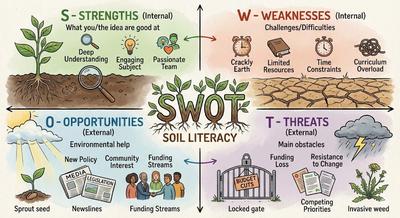
With your goals clarified, it’s time to look outward. Soil literacy thrives on partnerships, especially in secondary schools, where projects often span departments or require community expertise. In Section 2, you’ll map stakeholders, from local environmental NGOs to science labs, to build a support network that enriches your teaching and expands student opportunities. Following the 3 steps below will help you effectively map stakeholders and leverage their support to successfully implement your soil literacy project. Step 1: Stakeholder mapping Identify stakeholders: List all individuals and groups involved in decisions related to soil literacy at your school: teachers, parents, local authorities, environmental organizations, etc. Categorize stakeholders: Use this stakeholder map to place them into quadrants based on influence and interest. Then, ask the following questions: Knowledge – What do they already know about soil literacy? Beliefs – What are their educational values and perceptions of student-centred methods? Interests – Any personal factors (e.g., parents of students, political interests) that might affect their support? Impact – How will their support or opposition affect your project? Have a look at these Miro templates to start mapping out the stakeholders. Step 2: SWOT analysis Strengths: Internal advantages of soil literacy at your school (e.g., existing environmental curricula). Weaknesses: Internal challenges, such as resource limitations or lack of expertise. Opportunities: External factors like supportive local policies or community interest. Threats: External obstacles such as budget constraints or competing priorities. Perform this analysis specifically in relation to your school’s policy, institutional environment, and public opinion to understand potential barriers and enablers. Learn more about SWOT analysis here. Step 3: Identify advocacy tools Existing tools: Leverage existing channels such as educational policy documents, research findings, and existing teaching methods. Create new tools: Develop testimonials, infographics, and research summaries to support your case. Use digital platforms (e.g., newsletters, social media) while respecting privacy rights.
Same comment as for primary school teachers: Should there also be a link to the forum for them to discuss what they've come up with?
Personal Learning Objectives
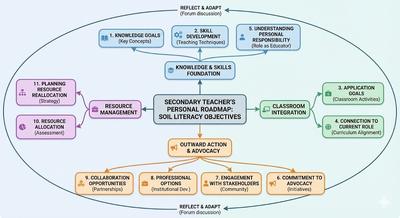
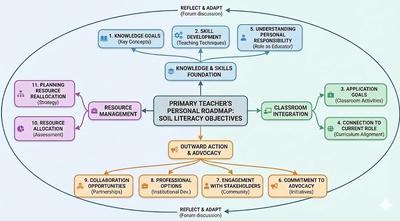
Think through the following steps and make short notes on which goals you can identify with. If you prefer, you can download the info below in spreadsheet format here and add your actions/reflections on your own document. 1. Knowledge goals Identify key soil literacy concepts relevant to primary education (e.g., basic soil types, importance of soil biodiversity). Example: Understand soil health indicators and how they apply to classroom projects. 2. Skill development Determine specific teaching skills to develop (e.g., facilitating outdoor learning activities, simple soil experiments). Example: Learn techniques for engaging young students in ecological assessments through soil investigations. 3. Application goals Specify practical ways to integrate acquired knowledge into classroom activities and school projects. Example: Design soil-based science projects or incorporate soil literacy themes into existing subjects like science and geography. 4. Connection to current role Align objectives: relate learning goals to your teaching responsibilities, focusing on enhancing the curriculum and supporting your role within the school. Example: Tailor soil literacy content to complement current lesson plans and teaching objectives, ensuring alignment with educational standards. 5. Understanding personal responsibility Role in education: Recognize your pivotal role in fostering soil literacy among students and colleagues. Be proactive in seeking out resources and opportunities for promoting sustainability education. Example: realising that if you don’t teach soil literacy, your students might never learn why healthy soil matters to our food, water, and climate. 6. Commitment to advocacy Develop initiatives that support your commitment to sustainable education practices. Example: Act as a champion for soil literacy by organizing awareness days or campaigns focused on soil conservation. 7. Engagement with stakeholders Plan engagement: Strategize on methods to collaborate with teachers, involve students, and engage the wider community. Example: Foster partnerships with local gardens or agricultural experts for interactive learning experiences like workshops or gardening projects. 8. Professional options Institutional development: Explore ways to incorporate soil literacy in programs, policies, and extracurricular activities. Example: Develop school policies that emphasize environmental education, and organize inter-class competitions on soil projects. 9. Collaboration opportunities Identify potential partnerships with community organizations or experts to enhance the soil literacy agenda. Example: Coordinate guest lectures with local ecologists or arrange visits to nearby farms. 10. Resource allocation Assess resources: Evaluate current resources and plan for what is needed to effectively integrate soil literacy. Example: Review the budget for field trips or materials needed for hands-on soil experiments. 11. Planning resource reallocation Create strategies to secure additional resources or reallocate existing ones to focus on soil literacy initiatives. Example: Allocate time during staff meetings for collaborative planning on soil-related projects. Forum reflection invitation: What thoughts come to your mind after mapping your personal objectives? Were some of the prompts helpful on your reflection? Did it help you finding some blindspots? You can share your filled spreadsheet here or share your experience overall, with peers. Click here to go to forum
Similar comments as for the primary teachers:
the second column of the table is cut off
the quality of the figure should be improved
the link to the forum doesn't work yet
Mapping stakeholders for Soil Literacy Projects
With your goals clarified, it’s time to look outward. Soil literacy thrives on partnerships, especially in secondary schools, where projects often span departments or require community expertise. In Section 2, you’ll map stakeholders, from local environmental NGOs to science labs, to build a support network that enriches your teaching and expands student opportunities. Following the 3 steps below will help you effectively map stakeholders and leverage their support to successfully implement your soil literacy project. Step 1: Stakeholder mapping Identify stakeholders: List all individuals and groups involved in decisions related to soil literacy at your school: teachers, parents, local authorities, environmental organizations, etc. Categorize stakeholders: Use this stakeholder map to place them into quadrants based on influence and interest. Then, ask the following questions: Knowledge – What do they already know about soil literacy? Beliefs – What are their educational values and perceptions of student-centred methods? Interests – Any personal factors (e.g., parents of students, political interests) that might affect their support? Impact – How will their support or opposition affect your project? Have a look at these Miro templates to start mapping out the stakeholders. Step 2: SWOT analysis Strengths: Internal advantages of soil literacy at your school (e.g., existing environmental curricula). Weaknesses: Internal challenges, such as resource limitations or lack of expertise. Opportunities: External factors like supportive local policies or community interest. Threats: External obstacles such as budget constraints or competing priorities. Perform this analysis specifically in relation to your school’s policy, institutional environment, and public opinion to understand potential barriers and enablers. Learn more about SWOT analysis here. Step 3: Identify advocacy tools Existing tools: Leverage existing channels such as educational policy documents, research findings, and existing teaching methods. Create new tools: Develop testimonials, infographics, and research summaries to support your case. Use digital platforms (e.g., newsletters, social media) while respecting privacy rights.
Should the participants also share in the forum what they've come up with like in many other modules? Just checking in case this was intended but not inserted here.
Personal Learning Objectives
Think through the following steps and make short notes on which goals you can identify with. If you prefer, you can download the info below in spreadsheet format here and add your actions/reflections on your own document. 1. Knowledge goals Identify key soil literacy concepts relevant to primary education (e.g., basic soil types, importance of soil biodiversity). Example: Understand soil health indicators and how they apply to classroom projects. 2. Skill development Determine specific teaching skills to develop (e.g., facilitating outdoor learning activities, simple soil experiments). Example: Learn techniques for engaging young students in ecological assessments through soil investigations. 3. Application goals Specify practical ways to integrate acquired knowledge into classroom activities and school projects. Example: Design soil-based science projects or incorporate soil literacy themes into existing subjects like science and geography. 4. Connection to current role Align objectives: relate learning goals to your teaching responsibilities, focusing on enhancing the curriculum and supporting your role within the school. Example: Tailor soil literacy content to complement current lesson plans and teaching objectives, ensuring alignment with educational standards. 5. Understanding personal responsibility Role in education: Recognize your pivotal role in fostering soil literacy among students and colleagues. Be proactive in seeking out resources and opportunities for promoting sustainability education. Example: realising that if you don’t teach soil literacy, your students might never learn why healthy soil matters to our food, water, and climate. 6. Commitment to advocacy Develop initiatives that support your commitment to sustainable education practices. Example: Act as a champion for soil literacy by organizing awareness days or campaigns focused on soil conservation. 7. Engagement with stakeholders Plan engagement: Strategize on methods to collaborate with teachers, involve students, and engage the wider community. Example: Foster partnerships with local gardens or agricultural experts for interactive learning experiences like workshops or gardening projects. 8. Professional options Institutional development: Explore ways to incorporate soil literacy in programs, policies, and extracurricular activities. Example: Develop school policies that emphasize environmental education, and organize inter-class competitions on soil projects. 9. Collaboration opportunities Identify potential partnerships with community organizations or experts to enhance the soil literacy agenda. Example: Coordinate guest lectures with local ecologists or arrange visits to nearby farms. 10. Resource allocation Assess resources: Evaluate current resources and plan for what is needed to effectively integrate soil literacy. Example: Review the budget for field trips or materials needed for hands-on soil experiments. 11. Planning resource reallocation Create strategies to secure additional resources or reallocate existing ones to focus on soil literacy initiatives. Example: Allocate time during staff meetings for collaborative planning on soil-related projects. Forum reflection invitation: What thoughts come to your mind after mapping your personal objectives? Were some of the prompts helpful on your reflection? Did it help you finding some blindspots? You can share your filled spreadsheet here or share your experience overall, with peers. Click here to go to forum
The table with possible learning objectives (1.-11.) is hard to read as the second column is cut off. Please adapt to make everything readable in the online version.
In the text the possibilty to download this table is mentioned. However, the file for download is missing.
The link to the forum does not work (error 404 page not found).
The quality of the figure should be improved.
Greening the curriculum: Soil Literacy Integration
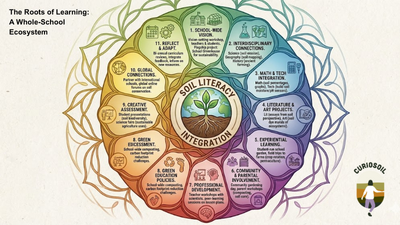
Advocacy opens doors; Section C of Module 2 ensures what’s taught inside them reflects your vision. Guidance on Greening the Curriculum provides templates to audit existing programs, integrate soil concepts across subjects (e.g., linking soil chemistry to math data units or land history to social studies), and train staff without overwhelming them. Forget top-down mandates, focus on scalable "lighthouse projects" that model success and attract organic adoption. Read the following tips on how soil literacy can be integrated into your curriculum. Choose at least one that you like best and think you could implement and commit to take steps forward by finishing the three sentences: In a week I will… In a month I will… In a year I will… Post your reflections in the forum and comment on at least one peer’s plan. 1. Develop a school-wide vision: Hold a vision-setting workshop with teachers and students to brainstorm ideas for integrating sustainability, focusing on creating a school greenhouse as a central project (e.g. organise a visioning workshop with teachers and students with the aim of co-creating a plan to build a school greenhouse as a flagship project for sustainability). 2. Establish interdisciplinary curriculum connections: In Science, conduct soil erosion experiments and explore organic vs. inorganic soil components in classroom labs. In Geography, map soil types in the local area and analyze how they have shaped local agriculture and settlement patterns. In History, research and present on ancient farming techniques and their reliance on soil health, such as the three-field system in medieval Europe. 3. Integrate Soil Literacy in Mathematics and Technology: Use soil sample composition to calculate percentages and graph results in Math classes. Develop a Technology project where students build simple sensors or coding tools to measure soil moisture or pH levels. 4. Enhance literature and art projects: Assign Literature classes to write essays or short stories from the perspective of soil during different historical periods. In Art, create a mural using natural dyes made from different soil samples, illustrating local ecosystems or community history. 5. Promote experiential learning: Develop a student-run school garden where different classes can plant and maintain plots based on lessons learned in class. Organize field trips to nearby farms for students to learn about practices like crop rotation and permaculture roadside. 6. Encourage community and parental involvement: Host a community gardening day inviting local horticulturists to discuss soil care, encouraging intergenerational knowledge exchange. Parents can participate in workshops where they and students work together on sustainable practices like composting at school. 7. Provide professional development: Organize teacher workshops with local environmental scientists discussing new research in soil conservation. Facilitate peer-learning sessions where teachers share successful soil literacy lesson plans and outcomes. 8. Implement green education policies: Launch a school-wide composting program, turning food waste into valuable soil amendments for the school garden. Set a challenge for each class to reduce their carbon footprint, presenting findings at a school assembly. 9. Utilize creative assessment methods: Use student presentations on soil biodiversity as part of their assessment in Biology. Facilitate science fairs where projects focus on innovative uses of soil in sustainable agriculture. 10. Foster global connections: Partner with a school in another country to compare soil health practices across diverse climates and cultures. Engage students in global online forums discussing international soil conservation efforts. 11. Reflect and adapt: Schedule bi-annual curriculum reviews where professional educators assess the impact of soil literacy projects and integrate student feedback to refine future efforts. Keep faculty informed about new soil and sustainability-related educational resources. Reflection task How do these ideas fit to your subject and school context? Share your commitments for 1 week, 1 month and 1 year... You can also comment on another colleague's plan and offer a suggestion or encouragement :)
Is it possible to improve the quality of the figure? It's hard to read this way both directly on the page and when I download.
There is a lot of space between the figure and the reflection task. Is it possible to delete this space?
Regarding the reflection task: I'm confused by the phrasing of the question "How does this activity fit into your subject and school context?". If the tips are meant, please rephrase e.g. like "How do these ideas fit to your subject and school context?"
-
In the last sentence, the . at the end is missing.
"You can also comment on another colleague's plan and offer a suggestion or encouragement. :)"
The link to the forum for the reflection task does not work (error message "404 Page Not found").
Done, only missing high quality image here.
At the end of the last sentence (Final tip:) there is a "." missing.
Is it possible to include an option for downloading these instructions as a separate file?
Done