

SUSTAINABILITY
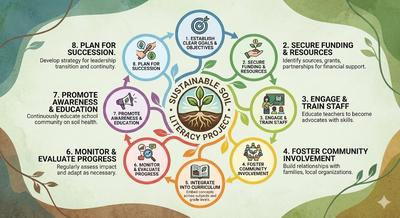
Module 4.D ensures it outlasts your tenure. Sustainability focuses on embedding soil literacy institutionally: training "Soil Champion" teachers, weaving garden maintenance into facilities budgets, or making soil projects a pillar of new staff orientation. We’ll confront attrition risks head-on, because true sustainability means the garden thrives when you’re pulled into the next crisis meeting. If you have managed to implement a successful project you need to make your success sustainable. Taking the following steps will ensure that your soil literacy project remains effective and sustainable over the long term. Steps to ensure sustainability: 1. Establish Clear Goals and Objectives: Define the long-term aims of the soil literacy project and how they align with the school’s mission and educational goals. 2. Secure Funding and Resources: Identify potential funding sources, grants, or partnerships to provide financial support and resources needed for the project’s continuation. 3. Engage and Train Staff: Educate and involve teachers and staff to become advocates and facilitators of the project, ensuring they have the necessary knowledge and skills. 4. Foster Community and Stakeholder Involvement: Build strong relationships with families, community members, local organizations, and experts to create a network of support. 5. Integrate into Curriculum: Embed soil literacy concepts into the school curriculum across multiple subjects and grade levels to ensure consistent delivery. 6. Monitor and Evaluate Progress: Regularly assess the project’s impact and effectiveness through student feedback and project metrics and adapt as necessary. 7. Promote Awareness and Education: Continuously educate the school community and promote awareness about the importance of soil health and sustainability. 8. Plan for Succession: Develop a strategy for leadership transition and continuity, ensuring the project can sustain itself beyond the current team’s involvement. The following checklist will help you make sure that you have considered all major aspects of making your efforts sustainable. Check it out and write a short reflection on which step you find the most problematic and why. Checklist for long-term sustainability: Set clearly defined goals and objectives aligned with school values. Identify and secure funding sources and partnerships. Provide training and resources for staff to ensure effective project delivery. Build and maintain strong relationships with community and external partners. Incorporate soil literacy into the school’s curriculum. Establish a system for regular monitoring and evaluation. Develop ongoing awareness and educational initiatives. Create a succession plan for leadership and project continuity. Take a moment to reflect (and share in the forum): Which of the above steps do you anticipate being the most challenging and why? Soil governance, done right, can transform your school’s ecosystem. You’ve moved from engaging parents as decision-makers (Section 4.1) to mobilizing the whole community as co-owners (Section 4.2), amplifying impact through targeted communication (Section 4.3), and locking in longevity (Section 4.4). Remember: Your goal isn’t a perfect program, it’s a self-replenishing culture. When budgets tighten or stakeholders waver, lean on the systems you’ve built. That parent-led soil safety protocol? It’s now policy. The partnership with the local nursery? It’s in the 5-year plan. Your legacy isn’t a garden, it’s the blueprint for how your school turns values into value. Soil teaches us: Depth creates resilience. Dig deep here, and your leadership roots will hold.

Communication and Disseminations of a Soil Literacy Project
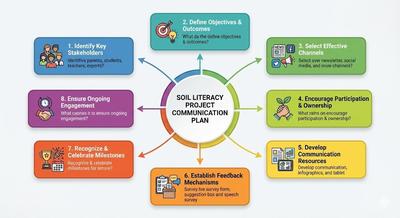
Even thriving partnerships stall without strategic storytelling. Section 3, Communication & Dissemination, equips you to showcase impact in ways that work for you. Turn soil projects into accreditation evidence ("See our cross-curricular soil module in our renewal report"), parent pride points ("Your child presented soil data to the town council"), or funding proposals ("Our compost program reduced waste costs by 30%"). Templates will help you delegate this: task student clubs with social media, or a teacher with grant-writing. Answering the following questions will help you think through the steps you need to take when communicating and disseminating your soil literacy project. Questions: 1. Who are the key stakeholders involved in the soil literacy project? Identify parents, students, teachers, local experts, and community organizations. 2. What are the main objectives and expected outcomes of the soil literacy project? Clearly define the goals and benefits for the school and community. 3. What communication channels are most effective for reaching each stakeholder group? Consider newsletters, social media, school meetings, and local events. 4. How can you encourage stakeholder participation and ownership in the project? Explore ways to involve stakeholders in planning and execution. 5. What resources and materials are needed to effectively communicate the project’s progress? Identify informational documents, visual aids, and digital content. 6. What feedback mechanisms should be in place to gather stakeholder input? Include surveys, suggestion boxes, and open forums for discussion. 7. How will you recognize and celebrate milestones and successes of the project? Plan events or communications to highlight achievements. 8. How can you ensure ongoing engagement and communication throughout the project’s lifecycle? Establish regular updates and checkpoints with stakeholders. The following checklist will help you make sure that you have considered all major aspects of communication and dissemination. Checklist: Identify and segment key stakeholders for targeted communication. Define clear objectives and outcomes for the project. Develop a communication plan with tailored strategies for each stakeholder group. Select and utilize effective communication channels (e.g., newsletters, social media). Create accessible and engaging resources/materials (e.g., brochures, infographics). Establish feedback loops for stakeholder input and adapt communication strategies accordingly. Schedule regular updates and keep stakeholders informed of project progress. Plan recognition and celebration of key milestones to maintain enthusiasm and support. Ensure long-term communication strategies are in place for continued engagement. Check out this guide on effectiveness communications by the Ministry of Education of New Zealand. This Schools Public Relations Best Practices can give you insights on your communications endeavours;

The links at the end are poorly visible, as they are not highlighted in a different color or otherwise clearly marked; only when hovering over the text does it become apparent that they are hyperlinks. Because they are not easily noticeable, fewer readers are likely to follow them, so it would be more effective to make the links more prominent.
Also the first link (guide on effectiveness communications by the Ministry of Education of New Zealand) is not working ("Module not found").
The whole school Approach
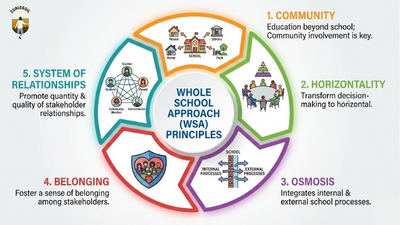
Parents invested? Now expand their role from supporters to co-architects. Section 2 shifts to whole-community engagement, where local farmers, businesses, and elders become governance partners. Learn to structure "Soil Stewardship Councils" that share ownership (e.g., a cafe owner donating compost bins, a retired agronomist advising student labs). This isn’t volunteerism, it’s resource diplomacy, converting community goodwill into tangible assets while distributing leadership burdens. The Whole School Approach (WSA) is an educational strategy that involves collective and collaborative action among learners, staff, and the broader community to enhance learning, behavior, and wellbeing across the entire school environment, fostering inclusivity and community involvement. This short animation shows an example of a WSA working: Principles of WSA: Community: Education extends beyond school; community involvement is key. Horizontality: Transform decision-making processes from hierarchical to horizontal. Osmosis: Integrates internal and external school processes. Belonging: Schools should foster a sense of belonging among stakeholders. System of relationships: Promote both the quantity and quality of stakeholders' relationships. Challenges: Community outsiders: Professionals may lack community integration; mutual cultural understanding is needed. Social class: Aim for equity but integrate diverse social groups. Digital: Question virtual community effectiveness in WSAs. Sustainability: WSA processes are sensitive to change; long-term sustainability is complex. Participation: Crucial for WSA; requires reformulating participation, reconstructing spaces, and rethinking strategies to enhance stakeholder involvement. The following practical tips can help you implement the whole school approach: Integrate soil education across curricula: Embed soil-related topics into various subjects like science, geography, and art to provide students with a comprehensive understanding of soil ecology and its significance. Create outdoor learning spaces: Develop school gardens or composting areas where students can engage in hands-on learning about soil health, sustainability, and biodiversity. Engage the community: Involve local experts, farmers, and environmental organizations to participate in school programs, providing insights and resources for soil-related projects. Host interactive workshops: Organize workshops and seminars for students, parents, and staff to learn about soil conservation practices and the role of healthy soil in the ecosystem. Develop student-led projects: Encourage student-led initiatives that focus on soil activities, such as soil testing experiments or community presentations on soil preservation. Incorporate technology: Use digital tools and platforms to explore soil science, like virtual soil collections, soil health monitoring apps, and interactive modeling tools. Encourage students to explore soil data online, engage with interactive maps, and analyze soil conditions globally. Establish a soil literacy committee: Form a committee with teachers, parents, and students to plan and oversee soil literacy activities, ensuring diverse input and sustained engagement. Regularly evaluate and adapt: Continuously assess the effectiveness of soil literacy initiatives and be open to adapting strategies based on feedback and changing educational needs. Check out this MOOC to learn more about Teaching Sustainability Awareness from a whole systems perspective
I understand the concept of WSA; however, I agree with Stephan that opening institutes and universities to the general public can disrupt regular work processes. For this reason, such activities should be limited to individual one-day events, such as ‘Science Day’ for primary and secondary school students at universities. We implement many such events at our faculty, and from experience I can say that they require extensive planning, strict safety measures, and continuous efforts to keep young students motivated and focused, while regular research work is put on hold.
The link in the end about Teaching Sustainability Awareness from a whole systems perspective is not working ("page not found").
ENGAGING PARENTS
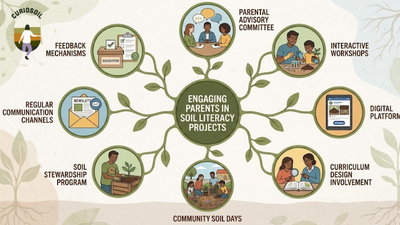
Engaging parents in a soil literacy project can greatly enhance school governance and foster a sense of community. Consider the tips below, choose one or two and note your thoughts about how you would implement it. Establish a parental advisory committee: Form a committee consisting of enthusiastic parents to help oversee the soil literacy project. This group can provide valuable input, assist in decision-making, and act as a liaison between the school and the wider parent community. Check out this article by Harvard's Graduate School of Education. Also this about Parent-Teacher Partnership. Organize interactive workshops: Host workshops where parents can learn alongside students about soil health, sustainable practices, and the importance of soil in daily life. Providing hands-on experiences can increase their involvement and commitment. Utilize digital platforms: Create an online portal or social media group dedicated to the project, where parents can find resources, share their own experiences, and contribute ideas for activities and curriculum enhancements. Involve parents in curriculum design: Invite parents with expertise in environmental science, agriculture, gardening or related fields to collaborate with teachers in designing and refining the curriculum. This inclusion can bring fresh perspectives and innovative ideas. Organize community soil days: Plan events where parents and their families can participate in activities such as soil testing, gardening workshops, environmental art projects related to soil conservation or creating compost. These events strengthen the school community and raise awareness about soil conservation. Link Suggestion – EU project for School Garden Material Develop a soil stewardship program: Encourage parents to volunteer as “Soil Stewards” who help maintain school gardens or conduct soil-related activities. Recognize and reward their contributions to build a stronger engagement culture. Set up regular communication channels: Ensure that parents are kept informed about the project’s progress, challenges, and successes through newsletters, emails, or regular meetings. Clear and consistent communication can foster transparency and trust. Incorporate feedback mechanisms: Establish ways for parents to provide feedback on the project's implementation and outcomes. This can be done through surveys or suggestion boxes, allowing them to voice their opinions and feel valued in the governance process.
Section "Establish a parental advisory committee": This group can provide valuable input, assist in decision-making, and act as a connection between the school and the wider parent community. Based on the CURIOSOIL messaging guidelines, simplicity is listed among the key principles and criteria; therefore, it would be advisable to use simpler wording to better capture readers’ attention. Additionally, the link to the first article by Harvard’s Graduate School of Education is not working (‘page not found’).
Section "Organize interactive workshops": When listing the learning outcomes, it is crucial to first introduce students and parents to soil ecosystem services and the importance of soil in everyday life. This approach will help motivate them, spark initial curiosity, and encourage a deeper interest in learning more about soil; therefore, it would be better to present this first and then continue with soil health and so on.
PARENTAL ENGAGEMENT
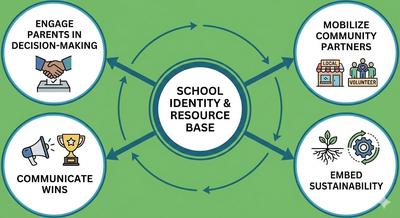
For school heads, soil literacy isn’t just curriculum, it’s community capital. Between budget reviews, parent expectations, and the push for "sustainable schools," you need frameworks that turn soil projects into strategic assets. This module tackles governance: how to deeply engage parents in decision-making, mobilize entire communities as partners, communicate wins to strengthen trust, and critically-embed sustainability so initiatives survive leadership transitions. The goal is to build systems where soil literacy fuels your school’s identity, resource base, and impact long-term. To promote soil literacy through education, professional educators need to co-operate with the parents and the community, not only because it is impossible to make relevant changes in the thinking of future generations without them, but also because the ecological notion of "everything is linked to everything else” suggests such an approach. In order to achieve such co-operation, school governance (and the governance of education at higher levels) must be transformed significantly so that families and the community can become actively engaged in education policy making and school life. This will lead to children becoming more active citizens who understand the importance of soil. There is a growing consensus on the changing role of school and education that needs a change of approach from educating obedient workers for the assembly line to educating creative, critical thinkers for a world of accelerated change and less need for repetitive work done by people. Decreasing participation, especially of younger generations as active citizens in community, elections and civic life is a worldwide phenomenon. Participatory practices in schools, engaging parents, children, teachers, and others are effective for school stakeholders to experience active citizenship in a safe environment, as well as the consequences of opting out of decision-making. Both parental engagement and child participation also have a direct positive effect on the learning outcomes of the children and also support the lifelong learning of parents and teachers. Student and parent organisations have long advocated for participatory decision making in education at all levels, from European and national policy making to daily decisions at school or class level. This demand has only become more topical after the school closures of 2020–22 when the problems of education systems became more visible to parents, and also for students. For many, the need to attend formal education became questionable. Parent organisations have long argued for engagement and participation, and to make school a safe testing field for democratic citizenship skills. So far, the prevalent approach to citizenship education has been the inclusion of the domain in the curriculum and thus creating the framework for learning about citizenship and democracy. The Curiosoil project is an excellent opportunity to change the main trend of civic/citizenship education from learning about to learning by doing. A meta-analysis study of over 13 000 scientific publications proves that students learn far better if they can experience curricular content rather than just learning about them. This is why the educational materials of the Curiosoil project contain not only hands-on activities, but also elements of parental and community engagement. This also means that teachers have three very important tasks that hopefully this MOOC can help with: Understand and prepare for their role in supporting parents in general to become better educators of their children as well as more active citizens, starting from school contexts, Understand and prepare for their role in acknowledging child agency and providing opportunities for meaningful participation of children of all ages, and Be active citizens of their own school.
First section: This module tackles governance: how to deeply engage parents in decision-making, mobilize entire communities as partners, communicate wins and achievements to strengthen trust, and critically-embed sustainability so initiatives survive leadership transitions.
Second section: In order to achieve such co-operation, school governance (and the governance of education at higher levels) must be transformed or at least modified significantly so that families and the community can become actively engaged in education policy making and school life.
Fifth section: The CURIOSOIL project is an excellent opportunity to change the main trend of civic/citizenship education from learning about to learning by doing. The CURIOSOIL Guidelines specify that the word ‘CURIOSOIL’ should be written in capital Latin alphabet letters.
First bullet point: Understand and prepare for their role in supporting parents to become better educators and role models for their children, as well as more active citizens, starting from school contexts.
PRACTICES AND TIPS TO FOSTER INCLUSIVITY
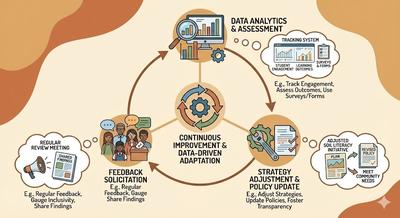
Promote a culture of respect and belonging: Develop a school ethos that celebrates diversity by organizing multicultural events and activities. Encourage open discussions about diversity and inclusion in school assemblies and classes. Address and challenge discriminatory behaviour immediately through restorative practices. E.g. Organize a "Soil Festival" to celebrate the diverse cultures and traditions connected to soil stewardship globally. Include storytelling sessions where students from various backgrounds share traditional farming or soil conservation practices from their cultures. Incorporate soil-related topics in school art and history projects, encouraging students to explore and present their cultural connections to soil and agriculture. Provide equitable learning opportunities: Ensure resources are distributed based on students' needs, with additional support for those facing language barriers or learning difficulties. Introduce differentiated instruction techniques to cater to various learning styles and abilities. Invest in assistive technologies that aid learning for students with disabilities. E.g. Introduce soil-based hands-on science projects, tailored to different learning levels, such as growing plants in varied soil types and observing differences. Set up a school garden or a small-scale farm where students can engage in experiential learning. Ensure accessibility for students with disabilities by including raised garden beds and providing ergonomic gardening tools. Utilize digital platforms with interactive soil-related simulations and activities that cater to diverse learning styles. Collect soil samples, drying and sieving them, then use them for creative activities Engage the community: Build partnerships with parents, local businesses, farmers, and community organizations to create a support network for students. Organize regular forums and workshops involving teachers, parents, and community members to discuss and implement inclusive strategies. Encourage volunteerism and mentorship programs to foster community engagement. E.g. Partner with local agricultural experts or environmental groups to host workshops for students and parents on soil health and conservation. Organize community gardening days that include workshops on soil types and planting techniques, allowing community members to share expertise and cultural practices regarding soil. Professional Development for Staff: Provide regular training for teachers on inclusive education practices and cultural competence. Encourage staff to share inclusive teaching strategies through professional learning communities. E.g. Support continuous learning by offering access to educational resources and workshops. (Check out our MOOC 2.2. LINK!) Offer teachers professional development sessions on integrating soil literacy into different curricula, such as science, geography, and social studies. Facilitate teacher exchanges or collaborations with schools that have successful soil literacy programs to share best practices and resources. Create an accessible environment: Conduct accessibility audits to ensure facilities cater to students with physical disabilities, such as ramps and accessible restrooms. Display clear signage and use visuals to aid navigation for all students. Ensure that classrooms are arranged to accommodate students' physical and sensory needs. E.g. Construct an accessible outdoor learning area for soil studies, including paths suitable for all mobility devices. Use tactile teaching tools and large print or audio resources for students with visual impairments during soil-related activities. Policy Development: Develop policies that clearly outline the school’s commitment to diversity and inclusion. Adapt curricula to reflect diverse cultures, ensuring representation of various perspectives and histories. E.g. Establish a reporting mechanism for discrimination or bias incidents, ensuring a safe and respectful environment. Draft policies that prioritize soil conservation education as part of the school’s commitment to sustainability and inclusivity. Revise existing curricula to incorporate soil literacy topics across subjects, ensuring representation of soil’s environmental, economic, and cultural significance. Monitoring and Evaluation: Use data analytics to assess the effectiveness of inclusion strategies and identify areas for improvement. Solicit feedback from students, parents, and staff regularly to gauge inclusivity efforts. Adjust strategies and policies based on feedback and data analysis to better meet the needs of the school community. E.g. Implement a system for tracking student engagement and learning outcomes from soil literacy activities, using surveys and feedback forms. Regularly review soil literacy initiatives' impact and share the findings with the school community to foster transparency and encourage continuous improvement.
In the section Provide equitable learning opportunities, there is excessive spacing at the beginning of the examples text. One example of a project could be collecting soil samples, drying and sieving them, then students could use it for creative activities.
In the section Professional Development for Staff, it would be beneficial to include training for teachers on different teaching approaches that address diverse student needs. Teachers could participate in seminars or workshops for this purpose. Additionally, a link is missing in the text.
In the section Create an accessible environment, the first bullet point contains an incomplete sentence and needs to be finished (“E.g. when …”).

@Katja Črnec Done
The link to the forum is not working; it returns a ‘page not found’ message. Also the link is not noticable in the text.
If we invite participants and encourage them to share their opinions on the forum, it would be beneficial to also explain what they will gain from doing so—namely, the opportunity to connect with others in similar situations, exchange experiences and ideas, and potentially find new inspiration for ensuring the long-term sustainability of the soil project.