

These days I manage a coffee grounds collection project to make compost and skin exfoliant while diverting them from landfill. I also grow a lot of food at our home garden, propagate and save seeds, promote ecosystems for biodiversity below and above ground and conduct workshops related to soil health, nutrition, composting, regeneration and conservation. I am also passionate about observing nature, apply nature based solutions and the connection between nature´s health and human health. I am a dedicated ambassador and learner about soil health, nature conservation and regeneration, agroecology, nutrition and animal rights.
These days I manage a coffee grounds collection project to make compost and skin exfoliant while diverting them from landfill. I also grow a lot of food at our home garden, propagate and save seeds, promote ecosystems for biodiversity below and above ground and conduct workshops related to soil heal…
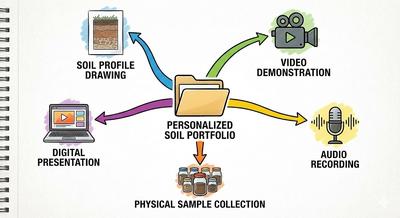
ACTIONS FOR INCLUSIVE SOIL LITERACY EDUCATION
1. Incorporate multi-sensory learning approaches Set up "Soil sensing stations" around the classroom where students rotate through different sensory experiences: Touch station: Soil texture assessment using the "feel method" with different soil types in labelled containers Smell station: Identifying earthy aromas of healthy soils versus compacted ones Visual station: Microscopes or magnifying glasses to observe soil components Sound station: Audio recordings of water percolating through different soil types 2. Connect soil education to local cultural context Relate soil science to local agricultural traditions, food systems, and cultural practices specific to your European region. Students can interview family members or research traditional agricultural practices from their cultural backgrounds, creating a classroom "Soil heritage map" showing different approaches to soil management across cultures. This helps make learning relevant for students from different cultural backgrounds. 3. Implement Universal Design for Learning (UDL) Provide flexible learning materials and multiple ways for students to engage with and demonstrate their understanding of soil concepts. Students can analyse soil health using multiple formats: - Digital soil testing apps with voice commands - Colour-changing test strips with large-print result guides - Physical manipulation tests with guided worksheets - Group collaboration options for those who benefit from peer support 4. Develop inclusive assessment methods Offer diverse ways for students to demonstrate soil knowledge. Students can create personalized soil literacy portfolios choosing from options like: Soil profile drawings with annotations Video demonstrations of soil tests Audio recordings explaining soil functions Physical soil sample collections with descriptions Digital presentations on soil organisms This respects different communication styles and abilities.


Integrating Soil Literacy in Extracurricular Activities
Soil literacy’s true power lies in transcending classroom walls. This lesson explores how to extend learning beyond formal curricula through student-led initiatives and collaborative partnerships. Discover how extracurricular activities can deepen engagement by empowering learners to apply soil science, ethics, and systems thinking in self-directed contexts. These opportunities nurture skills like critical analysis, leadership, and community advocacy, while reinforcing interdisciplinary connections made in class. Whether through hands-on investigations, creative expression, or civic projects, students gain agency to explore soil’s role in their lives—transforming passive learners into informed stewards of their environment and communities. These following examples of extracurricular activities creatively integrate soil literacy, engaging students and fostering a deeper connection to their environment and community. To enhance these activities, prioritize student leadership, encourage collaboration with local ‘experts’, and use multimedia tools to make soil literacy engaging and impactful. Choose one you like from the list and reflect on how you would implement it, and or how you would adapt it for your own needs. Alternatively, you can come up with your own. Share on the course forum and engage with your peers. Soil and sustainability club Activity ideas: Establish a student-led club focused on soil health and sustainability practices. Launch a school challenge for groups of students to develop innovative solutions to local problems related to soil, such as erosion, pollution or waste of organic matter. Organize regular meetings to discuss soil conservation, composting techniques, and sustainable agriculture. Projects: Initiate a community garden where students manage soil health through different methods, such as crop rotation and organic fertilization. Tips: Collaborate with local agriculture experts or community gardeners for workshops and guest lectures. Encourage students to document their gardening experiences through a blog or vlog for wider community engagement. / Encourage the use of design thinking methodologies. Create a ‘soil innovation fair’ for the groups to present their ideas to a jury made up of teachers, farmers and local technicians. Eco-art workshop Activity ideas: Conduct workshops where students create art using soil-derived pigments and/or soil (clay). Experiment with textures and colours by using different soil types to paint or craft pottery. Tips: Partner with local artists specializing in natural materials. Display student artwork in school exhibitions to raise awareness about soil diversity and its aesthetic potential, but also its possible practical uses (e.g. pots and mugs). Environmental film series Activity ideas: Organize a series of film screenings focusing on documentaries about soil health, agriculture, and the environment, followed by student-led discussions or panels. Tips: Facilitate critical thinking by having students compare the films to real-world soil challenges in their local communities. Encourage follow-up activities, such as creating short student documentaries or podcasts. Soil science Olympiad Activity Ideas: Host a science competition where students tackle soil-related problems, such as erosion solutions or soil biodiversity mapping. Tips: Include various categories like experiments, research papers, and presentations. Offer workshops to prepare students, focusing on skills such as soil testing and data analysis. Field trip series Activity Ideas: Plan visits to farms, nature reserves, or research stations to observe soil management practices firsthand. Include activities like soil sampling and biodiversity assessment. Tips: Engage with local agronomists or park rangers for guided tours. Encourage students to maintain field journals for reflections and data recording. Soil storytelling festival Activity Ideas: Organize a creative writing or storytelling event centred on soil themes, encouraging participants to explore the cultural and personal significance of soil. Tips: Open participation to all students to foster interdisciplinary involvement. Use storytelling to highlight diverse perspectives on soil health conservation and its impact on communities. Soil health awareness campaign Activity Ideas: Launch a school-wide awareness campaign educating peers about soil health's importance through posters, social media, and workshops. Tips: Encourage students to develop informational content and interactive activities demonstrating sustainable soil practices. Collaborate with environmental organizations to provide resources and support. Soil and cooking workshops Activity ideas: organise cooking workshops focusing on food produced in healthy soils. Students learn about the origin of ingredients, nutrition and sustainable cultivation techniques in a local to regional context. Tips: invite local chefs and/or organic farmers to share producte, recipes and stories. Include moments of tasting and reflections on the relationship between soil, food and health. Soil guardians programme Activity ideas: create a ‘soil guardians’ programme where students take responsibility for looking after the school's green areas, monitoring soil health and educating fellow students about good practices. Tips: create badges, field diaries and monthly awareness-raising events. Set measurable objectives, such as reducing organic waste or increasing vegetation cover (using endemic and appropriate plantings). Soil podcast Activity Ideas: Produce a series of episodes in audio format where students interview farmers, scientists or community members about stories and knowledge related to soil or explain various soil content/curiosities. Tips: use simple recording equipment and publish the episodes on the school website or social networks. Encourage the involvement of different areas (sciences, languages, computer science). This Soil Games page or this one may give you inspirations for creative ways of play and learn about soil. Soil isn’t just a topic, it’s a lens. Through this module, you’ve explored how to turn soil literacy into a bridge between your classroom and the community. You’ve identified your goals, mapped allies, designed projects, and discovered how soil can weave through every subject and beyond. Remember: You don’t need a perfect plan or a green thumb to start. A single pot of soil, a five-minute chat about earthworms, or a student’s question about “why dirt matters” can ignite a journey. As you move forward, return to this Module when in doubt or schedules overwhelm. Your work isn’t just about teaching soil; it’s about nurturing a generation that sees the ground beneath them as alive, connected, and worth caring for.

Maybe also add, local farmer visits for students to understand the reality of local farmers and ask questions to those who get their hands in the soil on a daily basis.
"ground" is misspelled on the last sentence.
on the image, what is the word "LUOLINER"? Also, "agency" and "stewardship" are doubled

Integrating Soil Literacy in Secondary School Subjects
Soil literacy isn’t confined to isolated projects, it’s a lens for interdisciplinary learning. This Section shifts focus to integrating soil concepts across secondary school subjects. Discover how to align soil themes with existing curricula, whether through data analysis, historical contexts, or social and ethical discussions. These strategies help students recognize soil’s role in interconnected systems, bridging classroom theory to global challenges like food security and climate resilience. The following list of examples might inspire you on how to integrate soil literacy in the regular subjects. Choose one from the list and reflect on how you would implement it in your class. Share your thoughts and ideas on the class forum and engage with your peers. Before getting into some experiements, check this 'what is dirt' video that can get kids students inspired to learn and practice more. The challenge may be to bring as many subject teachers to pull on the same string and include soil literacy into their own subject teaching as well as where and how to integrate and systemically weave the experiences and learnings together, which will likely be best through integrative projects (with participation from different subject areas) - see section 5. Examples for soil literacy projects grouped according to curricular connection Biology Microorganism exploration: Task students with identifying and classifying soil microorganisms through microscopic analysis. Have them create a biodiversity map illustrating different organisms' roles in soil health. Decomposition study: Develop a composting experiment where students investigate the decomposition rate of organic materials and its effect on soil nutrient content. Study of bioindicators: Identify earthworms and other organisms as indicators of soil health. Chemistry Soil pH investigation: Conduct experiments to measure the pH of different soil samples and research how acidity or alkalinity affects plant growth. Discuss chemical treatments to alter soil pH and their environmental impacts. Nutrient cycle project: Create a visual cycle of essential soil nutrients. Students can explore processes like nitrogen fixation and its importance to plant growth, with practical demonstrations using legumes. Pollution detectives: investigate sources of soil pollution (e.g. heavy metals, PFAS) through laboratory simulations with everyday materials. BioPplastics in the soil: studying the decomposition and effects of different types of plastics (including microplastic) and comparing them with homemade bioplastics. Geography Soil erosion models: Students construct scale models to simulate the effects of erosion and investigate mitigation strategies such as terracing or cover cropping. Soil world map: Create a project where students research and present on various soil types around the world, linking them to climate, vegetation, and agricultural practices. Impact of climate change: study of how desertification and erosion are advancing in certain areas of the world and the relationship with agricultural practices. Role of soil in carbon sequestration: Research and discuss about soil carbon content and its possible contribution to reduce CO2 levels and what the challenges with it are (e.g. conventional agriculture, land use changes, deforestattion) and compare to other CO2 reduction pathways Role and importance of (healthy) soils for the achievement of the SDGs: Explore the SDGs in general and in context of soil health (i.e. part of SDG15) and it relates to many other SDGs (e.g. SDG 1, 2, 6 12, and others), learning about complexity, interconnectedness, systems as well as global political agendas and agreements and how they relate to tangible issues on the ground within communities History Agricultural evolution: Investigate historical farming practices and their impact on soil health over time. Students present findings through a timeline, highlighting critical technological advances. Civilization and soil: Explore the role of soil in the rise and fall of ancient civilizations, such as Mesopotamia, and develop a comparative study with current agricultural practices. Study of great famines: how soil degradation contributed to historical episodes of food scarcity. Mathematics Data analysis: Instruct students to measure and record soil properties (e.g., moisture, density) over time. Use statistical methods to analyze and interpret results, perhaps in predicting crop yields. Geometry in landscaping: Design a sustainable garden using geometric shapes, teaching students to calculate area, volume of soil needed, and optimization of space for plant growth. Statistics on local agriculture: survey and statistical analysis of the region's agricultural production versus soil quality, use of excel and graphs. Visual arts Soil art projects: Use different colored soils to create earth art. Students can explore texture and color variations naturally found in soils for artistic expression. Photography and storytelling: Have students photograph soil-related subjects (erosion sites, vegetation changes) and create a narrative or photo essay reflecting on environmental changes and solutions. Analyse artworks connected to soil, e.g. Albrecht Dürer’s Great Piece of Turf using the method of artful thinking. Ask students to list 1. what they see, 2. what they think, 3. what they wonder about when looking at the painting. Music Soil symphony: Have students compose music pieces inspired by the natural sounds of soil and its environment, such as rustling leaves and raindrop patter. Encourage the creation of instruments from natural and recycled materials. Cultural exploration: Examine traditional music from agricultural societies, focusing on how soil and farming thematically appear in folk songs and instruments. Traditional farming songs: collect and interpret local to regional rural songs associated with working the land and soil fertility. Language arts Poetry in soil: Encourage creative writing where students compose poems about soil's life cycle, its ecosystem roles, and its metaphorical significance to life and growth cycles . Soil-themed debates: Organize debates on current soil-related issues, such as soil conservation techniques versus modern agricultural practices, enhancing research and public speaking skills. Analyse literary texts written about soil, e.g. see Vahni Capildeo poems below: Porosity you learn in school little scuttling things breathe through spiracles you learn the skin is the largest organ of the human body you won’t polish your toenails in case your toes can’t breathe but, child, who says the soil has porosity? emotion seeps into me as I see the field in which one thing then nothing can grow the saying goes may the road rise up to meet you which big man says soil, rise up, breathe, and live? I feel myself crumbling as the earth should crumble but does not a myriad creatures continue their glad ways in my gut yet the soil microbiome the skin of the earth and its innards have no words for their breathless their hardly recuperable state Extreme Environments do you mean shouting i mean pressure do you mean competition i mean petroleum do you mean war i mean acidity and alkalinity do you mean die i mean go dormant do you mean sleep i mean live do you mean survive i mean flourish and thrive do you mean exceptional i mean expected you mean expected things doing the unexpected think of yourself like a microbe think yourself into the microbiome Foreign language Soil vocabulary building: Teach students soil-related vocabulary in a foreign language, using context-rich activities like storytelling or dialogues set in farming communities abroad. International soil practices: Research and present on traditional soil management practices and agricultural terms in countries where the target language is spoken, enhancing cultural and environmental understanding. (R.R.) Chronicle or opinion piece: write about the urgent need to protect soils in order to guarantee our food future. Children's book on soils: writing and illustrating a story for children with characters from the underground ecosystem. Physical Education Gardening workouts: Develop fitness routines that mimic agricultural activities (e.g., digging, hoeing), teaching students about the physical exertion involved in farming and its health benefits. Soil science outdoor activities: Organize games or obstacle courses that simulate soil conservation techniques and their importance (e.g., building terraced slopes or avoiding erosion). Ethics Discussion on land use ethics: Facilitate debates and discussions on ethical questions surrounding soil usage, conservation strategies, and the ethics of land ownership and sustainable agriculture. Global responsibility project: Assign projects exploring how responsible soil management is a moral obligation to future generations, and dive into case studies on land restoration successes and failures. Global agendas for soil protection: Using the Agenda 2030 and SDGs as an example of trying to tackle many interrelated global to local issues and interrelated social, ecological and economic challenges and if and how they also related to soil, which is explicitly covered within SDG 15 (Life on Land) and connected to many others (e.g. SDG 1, 2, 3, 6, 11, 12 13). Religious Studies Soil in sacred texts: Explore references to soil and land stewardship in various religious texts, discussing their symbolic significance and teachings on caring for the Earth. Spiritual ecology: Investigate how different religions view humanity's relationship with the land, and develop reflective essays linking these perspectives to modern soil conservation efforts. Digital Sciences Soil data analytics: Teach students how to collect, analyze, and visualize soil quality data using digital tools, drawing on databases and GIS technology to map soil health and suggest improvements. Virtual reality simulations: Use VR software to simulate soil ecosystems and changes over time, offering immersive experiences on topics like the impact of erosion or the effects of different farming techniques. These examples can be customized and expanded based on the specific focus of the curriculum, school resources, and student interests, promoting a comprehensive and engaging approach to soil literacy in various educational contexts. Do you have more ideas of how to integrate Soil topics into everyday subjects? Share your ideas in the forum and interact with your peers.
What is the "section 5" mentioned on the sentence before Biology?
BioPlastics is misspelled on the Chemistry section.
Reforestation is misspelled on the geography section.
The image doesn't cover all the subjects mentioned in this section. Maybe creating a second image with the missing subjects would be more inclusive.
What is "Gnowth exuality" written on the image under "Mathematics".
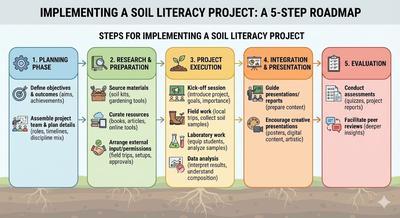
Creating a School Project on Soil Literacy
You’ll design a school project that goes beyond the classroom, like a soil pH study linked to urban farming or a debate on land-use policies. Templates and case studies will help you balance rigor with flexibility, ensuring projects align with curricular goals while sparking student agency. The following steps will assist you in designing a comprehensive school project focused on soil literacy, discussing pros and cons, and offering practical solutions and steps. Before starting your project, consider the pros and cons. This will help you advocate your idea to school stakeholders (your school head, parents, colleagues). Pros Environmental awareness: Enhances students' understanding of soil's role in ecosystems and its importance to biodiversity, food security and other ecosystems services. Interdisciplinary learning: Integrates subjects like biology, chemistry, geography, maths and environmental sciences but also social sciences and arts. Hands-on experience: Encourages practical learning through soil sampling, testing, and analysis and other work with soil (e.g. gardening). Critical thinking: Develops problem-solving skills by analyzing soil-related issues like erosion and contamination. Living Systems thinking: Learning to relate soil and soil ecology to many other complex systems (e.g. food production, water resources, pollution, climate change etc.) and how they interact and how we rely on them Sustainability learning: using soil literacy as a lively example for possible sustainability pathways for example in relation to sustainable food production, biodiversity, climate protection, personal and planetary health, inherent value of life support systems, deep personal and societal connection with and valuing nature Local focus: valuing the students' context and the local outdoors and local environment as well as local livelihoods Community Involvement: The project could partner with local farms, environmental groups, or conservation initiatives to give students real-world experiences with soil ecology and protection, enhancing the impact of the lessons taught in class Cons and solutions Resource intensive Requires materials and time for proper implementation. Solution: Collaborate with local environmental organizations, local farmers, local community gardens or garden centers or agricultural extensions to access resources, materials, money and expertise. Crowdsource materials from parents or the school community. Time constraints Solution: Integrate the project into the curriculum over several weeks or a semester to align with multiple subjects. Lack of expertise Solution: Organize workshops with soil scientists or use our MOOCs that offer educational materials on soil science. Feel free to reach out to us (LINK). Before exploring Steps for implementing a project, get inspired by some kids gardening activities here. Steps for implementing a soil literacy project 1. Planning phase - Define objectives and outcomes. What do you aim to achieve with the project? - Assemble a project team, including teachers from various disciplines and plan the project details together (including clear roles and responsibilities and timelines). 2. Research and preparation - Source materials such as soil testing kits and/or gardening tools. - Curate resources like books, articles, and online tools related to soil science. Arrange external input and/or permissions: Obtain necessary people and approvals for field trips or garden setups and other necessary resources. 3. Project execution - Kick-off session: Introduce the project and its importance in a school assembly or classroom discussion. Discuss project goals and the importance of soil in ecosystems and daily life - Field work: Organize field trips to local parks or agricultural sites. Students should collect soil samples for testing texture, pH, and nutrient levels. - Laboratory work: Equip students with basic lab techniques to analyze soil samples. - Data analysis: Teach students to interpret results and understand soil composition. 4. Integration and presentation Guide students in preparing presentations or reports. Encourage creative presentations such as posters or digital content like videos, but also include artistic representations. 5. Evaluation - Conduct assessments through quizzes or project reports. - Facilitate peer reviews for deeper insights. Check out this training (also from an EU funded project) and learn more ideas to train soil stewards. Write a short reflection on which of these steps you will implement and how. Which of these steps would you find easiest to implement in your school? And which would be the most challenging? Share why.
Another solution could be to have a "Garden Club" or "Environment Club" to help with logistics, allocate finances, assemble a team, etc.
On the "PROS" section, not all sentences end with a period. On the "CONS" section the link is missing for a contact for information.
Should there be a point 6, to either ADJUST OR ADAPT to the evaluation made?
There is not link to the training mentioned at the end.
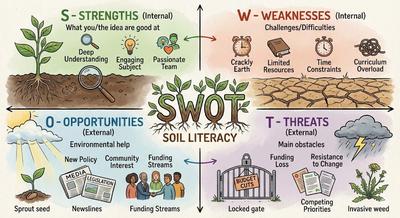
Mapping stakeholders for Soil Literacy Projects
With your goals clarified, it’s time to look outward. Soil literacy thrives on partnerships, especially in secondary schools, where projects often span departments or require community expertise. In Section 2, you’ll map stakeholders, from local environmental NGOs to science labs, to build a support network that enriches your teaching and expands student opportunities. Following the 3 steps below will help you effectively map stakeholders and leverage their support to successfully implement your soil literacy project. Step 1: Stakeholder mapping Identify stakeholders: List all individuals and groups involved in decisions related to soil literacy at your school: teachers, parents, local authorities, environmental organizations, etc. Categorize stakeholders: Use this stakeholder map to place them into quadrants based on influence and interest. Then, ask the following questions: Knowledge – What do they already know about soil literacy? Beliefs – What are their educational values and perceptions of student-centred methods? Interests – Any personal factors (e.g., parents of students, political interests) that might affect their support? Impact – How will their support or opposition affect your project? Have a look at these Miro templates to start mapping out the stakeholders. Step 2: SWOT analysis Strengths: Internal advantages of soil literacy at your school (e.g., existing environmental curricula). Weaknesses: Internal challenges, such as resource limitations or lack of expertise. Opportunities: External factors like supportive local policies or community interest. Threats: External obstacles such as budget constraints or competing priorities. Perform this analysis specifically in relation to your school’s policy, institutional environment, and public opinion to understand potential barriers and enablers. Learn more about SWOT analysis here. Step 3: Identify advocacy tools Existing tools: Leverage existing channels such as educational policy documents, research findings, and existing teaching methods. Create new tools: Develop testimonials, infographics, and research summaries to support your case. Use digital platforms (e.g., newsletters, social media) while respecting privacy rights.
There isn't a download button on the images as on the primary teacher's MOOC
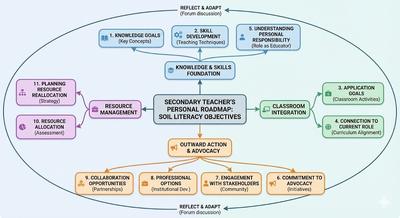
Personal Learning Objectives
Think through the following steps and make short notes on which goals you can identify with. If you prefer, you can download the info below in spreadsheet format here and add your actions/reflections on your own document. 1. Knowledge goals Identify key soil literacy concepts relevant to primary education (e.g., basic soil types, importance of soil biodiversity). Example: Understand soil health indicators and how they apply to classroom projects. 2. Skill development Determine specific teaching skills to develop (e.g., facilitating outdoor learning activities, simple soil experiments). Example: Learn techniques for engaging young students in ecological assessments through soil investigations. 3. Application goals Specify practical ways to integrate acquired knowledge into classroom activities and school projects. Example: Design soil-based science projects or incorporate soil literacy themes into existing subjects like science and geography. 4. Connection to current role Align objectives: relate learning goals to your teaching responsibilities, focusing on enhancing the curriculum and supporting your role within the school. Example: Tailor soil literacy content to complement current lesson plans and teaching objectives, ensuring alignment with educational standards. 5. Understanding personal responsibility Role in education: Recognize your pivotal role in fostering soil literacy among students and colleagues. Be proactive in seeking out resources and opportunities for promoting sustainability education. Example: realising that if you don’t teach soil literacy, your students might never learn why healthy soil matters to our food, water, and climate. 6. Commitment to advocacy Develop initiatives that support your commitment to sustainable education practices. Example: Act as a champion for soil literacy by organizing awareness days or campaigns focused on soil conservation. 7. Engagement with stakeholders Plan engagement: Strategize on methods to collaborate with teachers, involve students, and engage the wider community. Example: Foster partnerships with local gardens or agricultural experts for interactive learning experiences like workshops or gardening projects. 8. Professional options Institutional development: Explore ways to incorporate soil literacy in programs, policies, and extracurricular activities. Example: Develop school policies that emphasize environmental education, and organize inter-class competitions on soil projects. 9. Collaboration opportunities Identify potential partnerships with community organizations or experts to enhance the soil literacy agenda. Example: Coordinate guest lectures with local ecologists or arrange visits to nearby farms. 10. Resource allocation Assess resources: Evaluate current resources and plan for what is needed to effectively integrate soil literacy. Example: Review the budget for field trips or materials needed for hands-on soil experiments. 11. Planning resource reallocation Create strategies to secure additional resources or reallocate existing ones to focus on soil literacy initiatives. Example: Allocate time during staff meetings for collaborative planning on soil-related projects. Forum reflection invitation: What thoughts come to your mind after mapping your personal objectives? Were some of the prompts helpful on your reflection? Did it help you finding some blindspots? You can share your filled spreadsheet here or share your experience overall, with peers. Click here to go to forum
Also seeing formatting issues with the right side of the text getting cut off.
Image doesn't show the download button on the right side of the file name as on other lessons.
The Portuguese flag should be included in the second picture to not descriminate Portuguese teachers. Overal, it is very theoretical with few examples of how to do it in practice.
Or maybe no flags at all because this will be open source and available to anyone.
If i may suggest
Add an activity to ask family members about stories about them related to soil and then share with classmates.
Suggest to smell dry and moist soil, or soil from the playground and soil from the garden.
Learn how to take a soil sample. openknowledge.fao.org/server/api/core/bitstreams/c28b8d8d...
Test soil texture activity www.fao.org/fishery/docs/CDrom/FAO_Training/FAO_Training/...
Use identification guides to learn how to identify organisms like worms and other macrofauna existing in the soil.
For a deeper dive I suggest the European Soil Atlas(2005) https://esdac.jrc.ec.europa.eu/content/soil-atlas-europe or the Global Soil Atlas(2019) https://esdac.jrc.ec.europa.eu/content/global-soil-biodiversity-atlas