
Learning from Communities
Across Europe, many initiatives show how individuals, communities, and professionals translate soil awareness into practice. These initiatives often combine education, cultural engagement, and practical land stewardship.
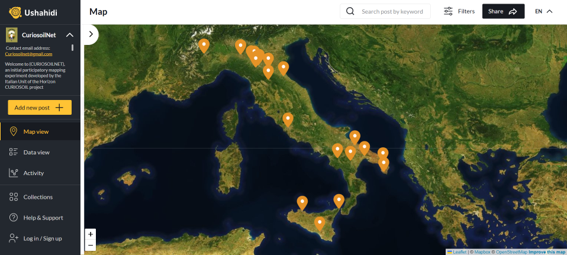
To make these efforts more visible, participatory mapping approaches are increasingly used. Such maps collect examples of soil-related initiatives and connect them geographically, allowing people to discover how soil stewardship takes shape in different places and contexts.
Participatory maps do more than display locations. They reveal networks of actors, ideas, and practices that contribute to soil protection and awareness.
The CURIOSOIL project participatory map (CuriosoilNet) brings together best practices in soil-related awareness raising, training, and non-formal and informal education, with a particular focus on vocational training and lifelong learning. Below are three examples featured in this map:
Composting and Circular Economy in the Educational Garden
Legambiente Cascina Govean – Environmental Education Centre, Italy
Target group: Secondary school students (approximately 13–18 years old)
This initiative engages secondary school students in hands-on learning about composting and soil regeneration through activities in an educational garden. Working in small groups, participants explore different stages of the compost cycle, from collecting organic materials to applying mature compost in cultivation beds.
By experiencing how organic waste can be transformed into fertile soil, students learn about circular resource use, soil biodiversity, and sustainable food production.
Emilio Sereni Landscape School
Istituto Alcide Cervi – Gattatico, Italy
Target group: Adults, students, local authorities, and civil society organisations
The Emilio Sereni Landscape School is a multidisciplinary training programme dedicated to the study of landscapes, with a particular focus on the Italian agricultural landscape. Hosted by the Istituto Alcide Cervi, the programme brings together scholars, professionals, and participants interested in environmental and territorial issues.
Through seminars, discussions, and field-based learning, participants explore how agricultural systems, land-use choices, and cultural traditions shape landscapes over time. The initiative promotes a vision of territorial development that places environmental sustainability, local identity, and landscape heritage at the centre of decision-making.
Racconti di Terra – Intergenerational Dialogue on Soil
Italian partners of the EU projects CURIOSOIL, LOESS and NBSoil, in collaboration with the Sustainability Education Network of Emilia-Romagna (Italy) Target group: Primary school students (approximately 6–11 years old)
“Racconti di Terra” (Stories of the Soil) is an educational initiative developed in connection with World Soil Day, encouraging children to explore the relationship between soil, culture, and local landscapes through intergenerational dialogue. In participating schools, students collect stories and memories about soil from grandparents and older community members.

the last photo is from the previous lesson, is that correct?