
Soil may look simple, but what is it really made of?
Soil may appear simple at first glance – just brown material covering the ground. However, a handful of soil is a complex and dynamic system. Among other things, it stores organic matter and water, supports plant growth, hosts enormous biodiversity, and helps regulate Earth’s climate. To understand why soil matters, it is useful to know what it is made of.
Soils are composed of various components, including minerals, organic matter, living organisms, water and air in varying proportions. We say that soil is defined as a three-phase system consisting of solid, liquid, and gaseous phases. The solid phase comprises mineral and organic particles, the liquid phase is water containing dissolved substances, and the gaseous phase is soil air. Together, these components determine how soil looks, feels, and functions in both natural and managed environments.
Minerals and organic matter form the framework of soils. Minerals originate from base rocks. Organic substances come from living or once-living organisms. They are carbon-based materials that usually contain carbon–hydrogen (C–H) bonds and include plant residues, (micro)organisms, and soil organic matter. Soil organic matter is the dark-coloured material, typically accumulated in the upper soil layers, formed when plant and animal remains decompose in the soil.
In contrast, inorganic substances are mainly mineral materials that do not contain these C–H bonds. They are typically derived from rocks and minerals rather than from living organisms.
Some minerals found in soils formed long ago during rock formation, such as quartz, feldspars, or mica. Other minerals form later on, as rocks slowly break down through weathering. Weathering is the natural and gradual process by which rocks and minerals at Earth’s surface are broken down or dissolved into smaller pieces by rain, salt, root activity, animal movements, and significant temperature changes.
Very small particles, including clay minerals and iron or aluminum oxides, are especially important because they strongly influence how soil retains water and nutrients. Although tiny, they help determine whether soil can support plant growth and life below ground.
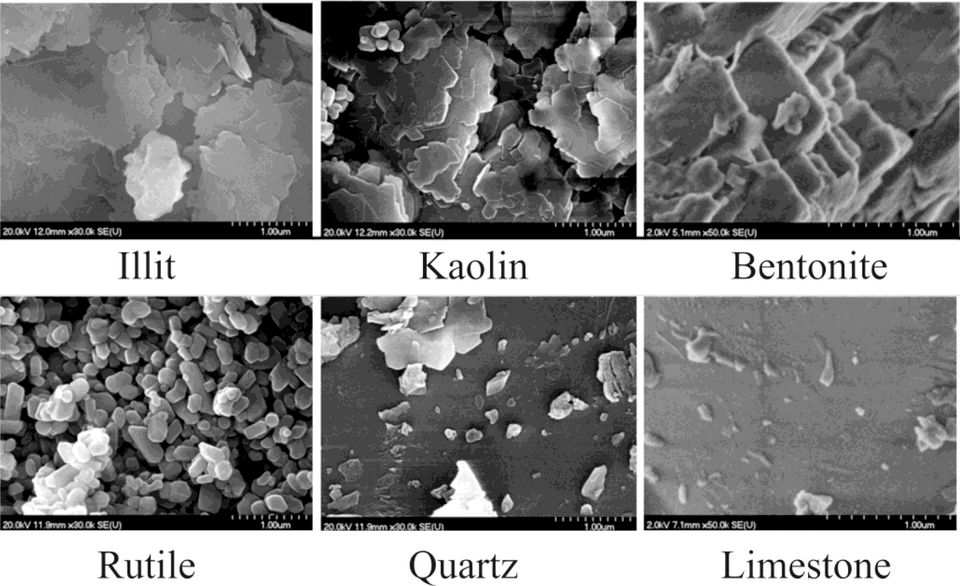
© SEM pictures of mineral dust components including the clay mineral illit, kaolin and the clay mineral mixture bentonite (upper row) by N. Utry et al., CC BY 3.0, no changes were made to the original photo

The name is different on the image and the photo caption: illit or illite? kaolin or kaolinite?