
Soil forming factors: How do soils develop?
As we have seen, soils have a history. Some are relatively young, others have been developing for thousands of years or even more. And none of them are ever truly finished. Soils are constantly changing, just like we all age over time. What we observe in a soil profile is a snapshot – the result of long-term interactions between rock, water, air, life, landscape, and time. When we prepare a soil monolith, we capture only one moment in this ongoing process. The soil remaining in the field continues to evolve.
The beginning: From rock to soil
Every soil begins with a geological foundation. At its “birth” lies rock – either solid bedrock or loose sediments transported by wind, water, ice, or gravity. In soil science, this starting material is called parent material. Through weathering, rock gradually breaks down into smaller particles. Water plays a central role in this transformation. In warm and humid climates, chemical reactions proceed faster, accelerating soil development. But cold climates are not inactive. When water freezes in rock cracks, it expands – much like a glass bottle breaking in a freezer – and slowly splits the rock apart. Over time, even solid rock becomes fragmented.
As soon as microorganisms, plants, and other organisms colonise this material, the process intensifies. Microbes feed on minerals released from weathering and produce substances that enhance further breakdown. Plant roots penetrate cracks and add organic matter as plants grow and decay. Mineral particles and organic residues begin to mix. Gradually, a thin surface layer forms - and, over centuries and millennia, deepens into soil. To better understand why soils differ from place to place, soil science summarises this complex story into five interacting factors.
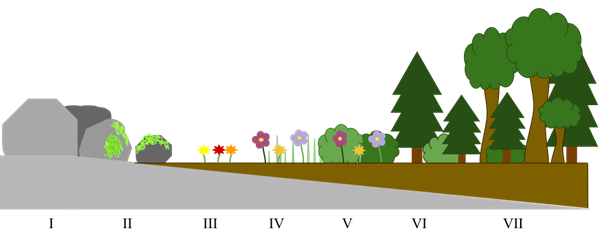
© Primary succession diagram by Rcole 17, CC BY-SA 4.0, no changes were made to the original photo
 Please log in or register to post a comment