
Soils in the landscape
Until now, we have mostly looked at soils as vertical slices - profiles, horizons, monoliths. We have zoomed in closely, like detectives studying evidence. But soils do not exist in isolation. They are part of landscapes. A soil profile only makes full sense when we understand where it is located: On a steep slope or in a valley? Under forest or grassland? In a dry region or a humid one? Near a river, on a plateau, at the foot of a mountain?
When we place a soil profile back into its landscape context, we begin to see patterns. Soils on hilltops often differ from soils at the slope base. Water flows downhill. Sediments accumulate in depressions. Sun exposure changes microclimates. Vegetation responds to these differences -and in turn influences soil development. In other words: Landscapes shape soils and soils shape landscapes.
If you stand in front of an open soil profile in the field, you are not just looking downward. You are also reading the surroundings. The vegetation above, the slope you are standing on, the stones under your feet, the moisture in the air - all of these are part of the same story.
Watch the following video about a soil profile in a forest in Germany. Please focus on the sections from 2:56 to 12:10 and from 22:30 to 24:30. Notice not only how the soil profile is described, but also how the speaker connects it to the landscape around it.
As you watch, consider:
- What landscape features influence this soil?
- Which soil-forming processes might be active here?
- How does the vegetation relate to the soil properties?
- What features can you use to determine where one soil horizon ends and the next begins?
The goal is not to memorize details, but to practice seeing soil as part of a dynamic and living system.
Are you ready for more fascinating glimpses at above- and belowground landscapes? Look at these photos taken at different locations in Switzerland.
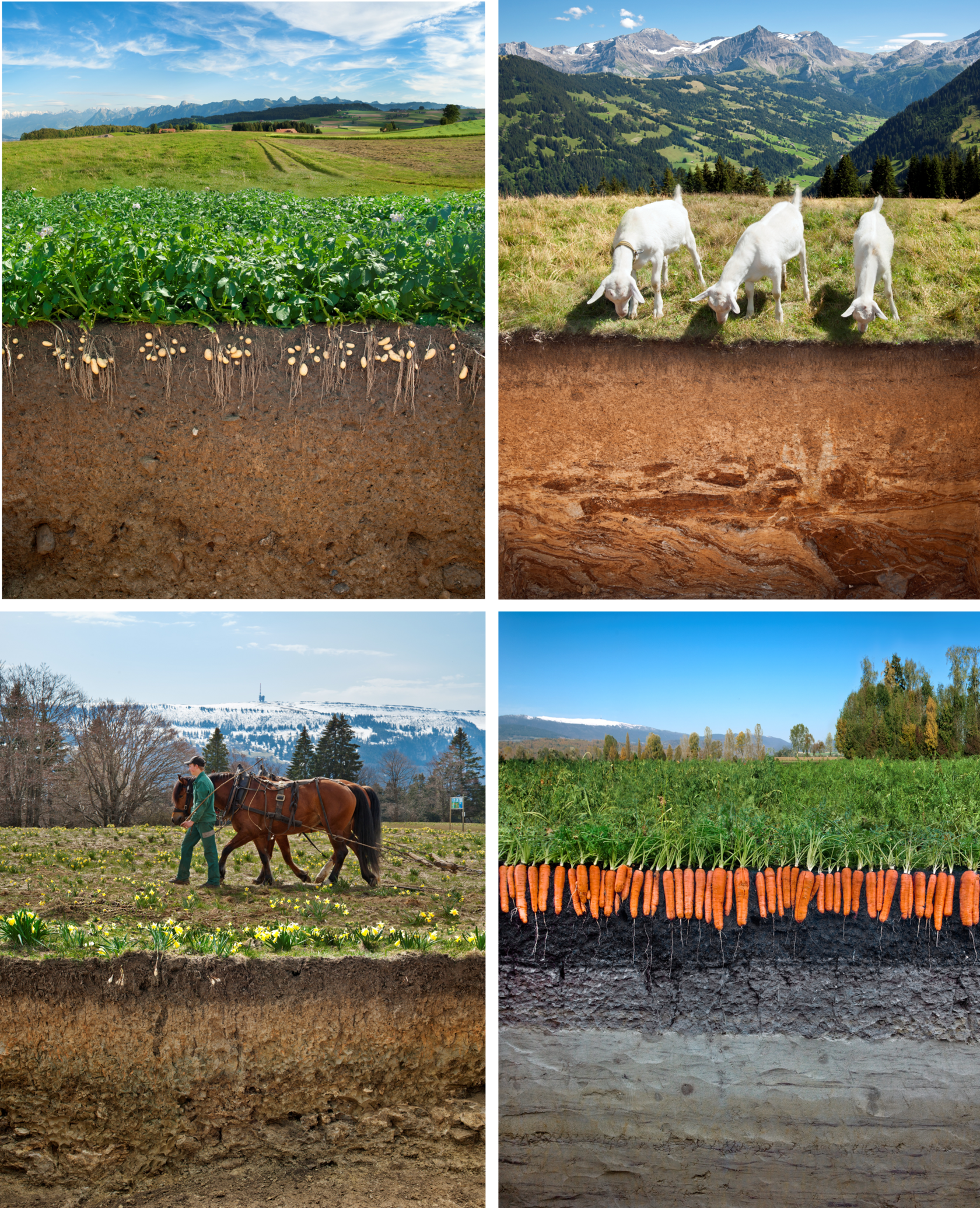
© Soil profiles in Switzerland as part of the calendar “Faszination Boden” by Gabriela Brändle, Urs Zihlmann (Agroscope) and Andreas Chervet (LANAT)
 Please log in or register to post a comment